
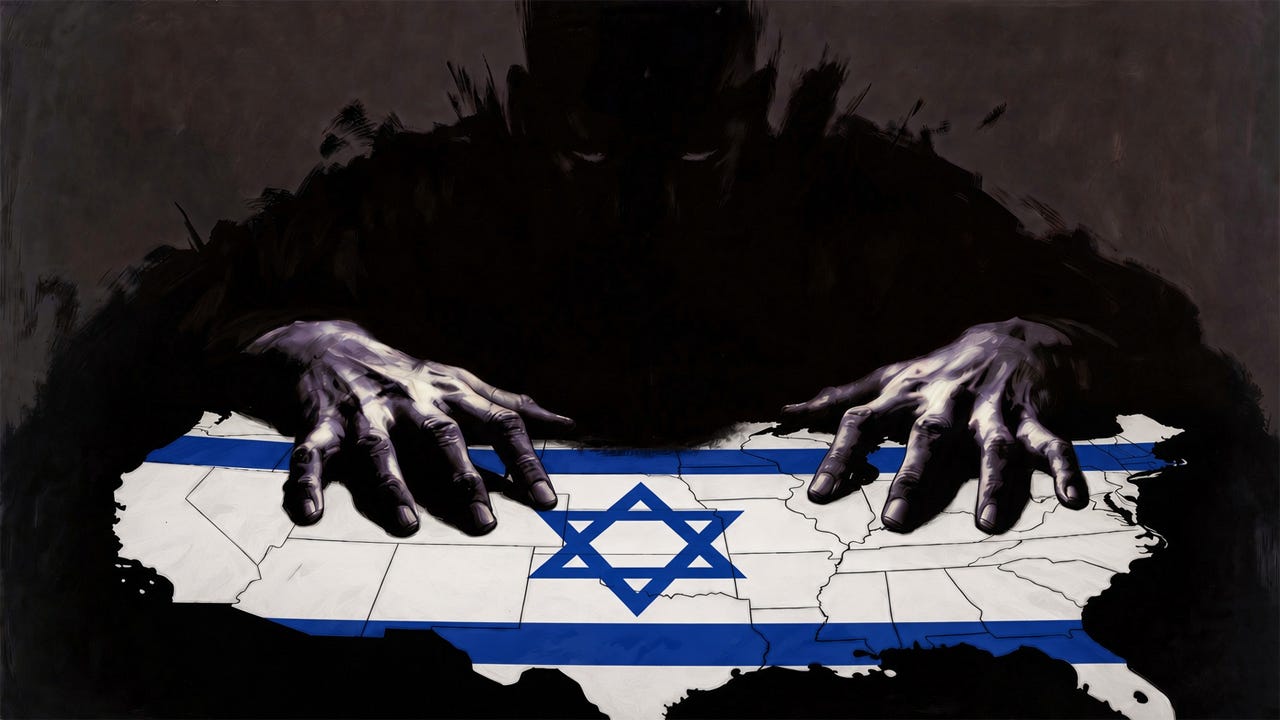
I used to believe that American foreign policy in the Middle East was all about Israel, that everything from Beirut to Baghdad had to do with orders from Tel Aviv, and that anyone who said otherwise was either naive or a shill. If only we took Israel out of the picture, we’d no longer have any reason to be in the region. The wars would stop; we could close down our bases and bring all our troops home.
It’s a nice fantasy, but we have to focus on reality.
Let’s go back in time and see what America said its interests were in its own documents.
February 18, 1943, Franklin Roosevelt writes to his Lend-Lease administrator: “I hereby find that the defense of Saudi Arabia is vital to the defense of the United States.” That’s the State Department’s published record of American foreign relations, which opened American military aid to the Saudi kingdom. Israel wouldn’t be established until 1948, so clearly this wasn’t because of Israel.
In August 1945, the United States signed a lease on an airfield at Dhahran—the first American military facility on the Arabian Peninsula. Again, before Israel’s existence.
January 23, 1980, Jimmy Carter’s State of the Union. He calls the Persian Gulf a region “of great strategic importance,” notes that it holds more than two-thirds of the world’s exportable oil, and points out that Soviet troops in Afghanistan now sit within 300 miles of the Strait of Hormuz, through which most of that oil has to pass. Then: “Let our position be absolutely clear: An attempt by any outside force to gain control of the Persian Gulf region will be regarded as an assault on the vital interests of the United States of America, and such an assault will be repelled by any means necessary, including military force.”
Out of that speech came the Rapid Deployment Force, which became US Central Command (CENTCOM) in 1983—the headquarters that has run every American war in that region since.
In 1987 and 1988, the US Navy flagged Kuwaiti oil tankers under the American flag and escorted them through the Gulf because Iran was attacking shipping. It was the largest naval convoy operation since WWII. This was not done for Israel.
When a frigate, the Samuel B. Roberts, hit an Iranian mine, the Navy responded by sinking Iranian ships and shelling Iranian oil platforms.
America battled at sea with Iran to protect Arab oil exports, not Israeli ones.
And the clearest case of all.
In the 1980s, America supported Saddam Hussein against Iran. And in 1991, America destroyed his army. During the Gulf War, we pressed Israel not to retaliate for Iraqi missile attacks, and Israel stayed out.
Now the material interests, with actual numbers.
In 2024, roughly 20 million barrels of oil a day moved through the Strait of Hormuz. That’s about a fifth of global petroleum consumption and more than a quarter of all seaborne oil trade. Close to a fifth of the world’s liquefied natural gas goes through the same strait, most of it Qatari.
Although America is now a net petroleum exporter, and very little Gulf crude reaches American refineries, the price of oil is global, not local. A closure of Hormuz raises the price at a gas station in New Jersey whether or not a single barrel in that tank came from the Gulf. The market doesn’t care where you bought it, and it’s why the US Navy is still there.
Our bases follow from the same logic for a different reason: Bahrain, Qatar, Kuwait, the UAE, and Diego Garcia—every one of those leases is with an Arab or British host government. If American policy in the region were simply about Israel, you’d have to explain why our military hardware sits on Arab soil, paid for with Arab cooperation, and why the Gulf monarchies keep renewing.
Despite many people falling for the conspiracy theory that all terrorism is really the CIA or Mossad, al-Qaeda, ISIS, and Iranian proxies have killed Americans in Beirut, at Khobar Towers, at two embassies in Africa, on the Cole, and in New York on 9/11. If these people realized that they were being duped by the RGB propaganda machine, they’d understand why we must maintain our military presence in the region.
What about Iran getting a nuclear weapon?
I also used to think it wouldn’t be a bad thing, that it would actually prevent WWIII. But Iran getting a nuclear weapon would cause Saudi Arabia and Turkey to follow suit, which matters to Washington because of oil and bases and treaty commitments. Russia, our enemy, sells arms and buys influence there. China, our enemy, buys the oil and builds the ports. And the Gulf states are among the largest customers for American weapons, which is both an industry interest and a way of keeping those militaries dependent on our equipment rather than Chinese or Russian.
How does any of this benefit Israel? If anything, it benefits the military-industrial complex.
Let’s not forget the petrodollar.
The petrodollar also gives America the sanctions power that comes from controlling dollar clearing, which is the most-used instrument in American foreign policy and runs entirely on the fact that the world’s oil money moves through American banks. It creates a standing bid for Treasury securities from the largest exporters on earth, which lowers what the government pays to borrow. And it means the energy trade of the planet runs through plumbing we can see into.
Iran sells outside the dollar, and Russia sells to China and India in yuan and rupees. BRICS is the multipolarism’s attempt to get around our sanctioning power. But Saudi Arabia, the UAE, Kuwait, and Qatar all still use dollars—the Saudis still insist on dollars from Chinese buyers who would much rather pay in yuan. If we leave the region, and our enemies fill the power vacuum, why would those governments keep selling oil in our currency? Why would Riyadh keep insisting on dollars from Beijing once Beijing is the one guaranteeing its security instead of us?
None of this has to do with Israel.
But it would be disingenuous to say that Israel has nothing to do with our foreign policy.
The alliance is real, and the lobbies are real. AIPAC files under the Lobbying Disclosure Act, spends money, runs primaries, and is very good at its job. They openly brag that 95% of their candidates get elected. American policy on Israel-specific questions—aid packages, vetoes at the Security Council, the language used about settlements—is demonstrably shaped by domestic political pressure.
The problem with the “Israel-controls-everything” narrative is that it doesn’t explain the Fifth Fleet, the Carter Doctrine, CENTCOM, Hormuz, and forty years of balancing Iraq against Iran. At this point, the conspiracy theorists have to shift to claims of Greater Israel to justify our presence, that we are there to help Israel expand its borders. But as I’ve shown, we have had interests in the region before Israel’s existence.
The deeper claim isn’t that Americans support Israel; it’s that the American government has been captured by it—through assassinations, espionage, and the threat of Mossad-backed terror attacks—so that every politician complies out of fear. But that theory needs Israel to be omnipotent and desperate at the same time. You don’t run a spy inside naval intelligence, as Israel did with Jonathan Pollard in the 1980s, to get information from a government you already own. You also don’t have to buy primaries in public, under federal disclosure law, one district at a time.
What the theory has to ignore is everybody else who wants the same things for their own reasons. There are roughly 7.5 million Jews in the United States. There are tens of millions of evangelical Christians, and Christians United for Israel alone claims over ten million members. There are nearly four times more Christian Zionists in America than there are Jews, and they hold that position because of what they believe about scripture.
And ethnic solidarity in American politics is completely normal. Irish-Americans cared about Ireland and acted on it. Cuban-Americans shaped policy toward Cuba for fifty years. Greek-Americans got an arms embargo imposed on Turkey in 1974. Nobody calls it capture when anyone else does it.
What about Operation Iraqi Freedom and Operation Enduring Freedom? I was part of both, so I want to weigh in on this.
People will tell you the war party was Jewish. Indeed, several prominent neoconservatives were, and some of them had Israeli security in their arguments; I’m not going to pretend otherwise. But the founding statement of the PNAC was signed by Cheney, Rumsfeld, Jeb Bush, and Dan Quayle; the men who actually made the decision were Bush, Cheney, Rumsfeld, Rice, Powell, and Tenet. And this is what I got wrong for 15 years: even where the advocates were Jewish, the arguments weren’t about Israel. They were about oil, a collapsing sanctions regime, a hegemon in the wrong place, and an administration that had just been hit by the worst terror attack in American history—on 9/11.
I’m convinced that the attitude must have been to take out every enemy we had in the region, doing so while Americans were willing. The reasons for the war were certainly propagandized, and there were special interests behind it, but it also did serve as a message to Islamists: if you attack us, we will bury you. And since then, there hasn’t been a large-scale terror attack from a jihadist group on American soil in 25 years.
Now let’s imagine what actually disappears if we cut Israel out of the picture: we lose an intelligence partner, a weapons development partner, and a domestic political constituency. I’d assume the Israelis would then have to seek a partnership with Russia or China for their own survival.
What doesn’t disappear is the oil. The strait doesn’t move. The bases stay where they are, on Arab land, under Arab leases. The question of who controls the Gulf still has to be answered by somebody, and America losing influence in the region doesn’t benefit us whatsoever, but it does benefit our adversaries.
If you still believe everything we do in the Middle East is because of Israel, then take any American action in the region and ask what else would explain it. If the answer is always Israel, then you’re the one who’s been captured by anti-American propagandists who want us out of the region.
Does Israel really run American foreign policy is a very good question. Undoubtedly, it's always been the Americans who run U.S. foreign policy. Keep up the great writing and thanks for serving in the USMC. Your healthy doses of reality are much appreciated.
This was my favorite part of your article:
“And ethnic solidarity in American politics is completely normal. Irish-Americans cared about Ireland and acted on it. Cuban-Americans shaped policy toward Cuba for fifty years. Greek-Americans got an arms embargo imposed on Turkey in 1974. Nobody calls it capture when anyone else does it.”
Other ethnic groups, such as Ukrainians and Armenians, also work relentlessly for their interests—and more power to them. Yet we seem to be the only ones singled out when we try to defend and protect our own people.
As you know, the claim that “Jews control America” or “Israel controls America” is nothing new. We simply see more of it now because of social media and people like Jake Shields who amplify those messages.
Not long ago I finished reading The Turner Diaries. It contains almost the exact same rhetoric you see on X today from the so-called Red-Green-Brown alliance - nearly word for word. And look at the damage that book caused and the terrorist attacks it inspired. Tim McVeigh was Irish-American; no one blames Ireland for the Oklahoma City bombing.
I actually think it’s the other way around: the United States has far more influence over Israel than Israel has over the United States. And I’m fine with that. America is the dominant power in the world, so I have no problem with it telling other countries what to do. We do it all the time - that’s how we maintain global hegemony, something no other country can currently claim. Not even China, no matter how hard it tries. The USA is the BOSS, and that's a good thing!
Once again, great work and great research. People like you are heroes for pushing back against false propaganda. Now we just have to get Alex Karp to clone the new version of you, since the old one is no longer around - or so they say. :)
Hope you’re enjoying your Sunday.