
Is the Universe Thinking?

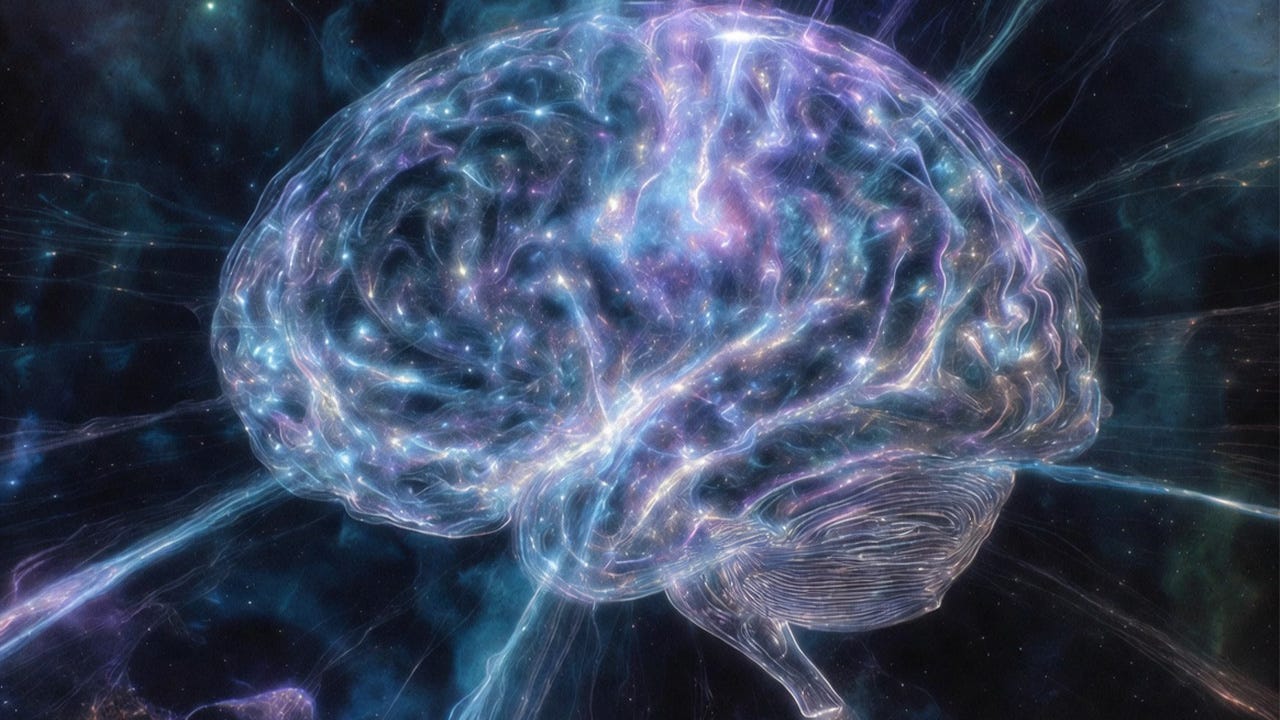
The Big Bang was either a singularity collapsing into expansion or a quantum vacuum fluctuation—the cosmologists are still working that out. But either way, something dynamic happened that destabilized a prior state and generated a sequence of events that has been unfolding ever since.
Here’s what struck me: that description also fits thinking.
While working on dissolving the Agrippa Trilemma, I had to analyze precisely how we humans think and acquire our knowledge. When we have a stable cognitive state, a thought, which is a dynamic event, destabilizes it and generates a sequence. One thought connects to the next; the chain unfolds. Nobody—including the thinker—fully controls where it goes. This parallel isn’t just poetic. I think it points at something structurally real, something that my framework of Infostructural Monism (ISM) is designed to articulate: that thinking and cosmic unfolding are not analogous processes; they are both instances of the same fundamental process.
The First Thought Was an Expansion
Consider what the Big Bang actually was, structurally: a singular, enclosed state that became dynamic. Something shifted. A fluctuation. An instability. And from that instability, a sequence of increasing complexity began—particles, atoms, molecules, stars, galaxies, neurons, minds.
In the second premise of the PIE Syllogism, dynamic events cause instability that drives epistemic warrant. Perhaps the universe had its own version of that event. Call it the first domain expansion. Not in the gaming sense, but in the literal sense: something enclosed became extended. Something static became a process, and that process is ongoing.
What was the original cause? We don’t know. This is where theists can sneak in God, and we couldn’t honestly say that it’s impossible. However, it could be possible that a quantum fluctuation has no cause in the classical sense. But structurally, the transition from singular stasis to dynamic unfolding seems to me, from the outside, exactly like what happens when a thought begins. You don’t choose your first thought when you wake up; it just happens. And when it does, it destabilizes silence and generates a sequence. The universe did something like that, except there was no outside observer, and there still isn’t.
What Is a Mind?
We don’t have a settled account of consciousness. We don’t know what thinking fundamentally is. What we do know is that it’s a physical process. Neurons are not mystical entities; they are biological structures that fire electrochemical signals in patterns. Those patterns, sufficiently complex and organized, produce something we call mind.
Now look at the large-scale structure of the universe. The cosmic web—the filaments of dark matter and galaxy clusters connecting across billions of light years—is visually indistinguishable from a neuron network. This isn’t woo-woo. It’s a morphological observation with a structural interpretation: complex, connected, dynamic physical systems, at wildly different scales, exhibit the same organizational patterns.
ISM’s neutral substrate monism doesn’t require us to know what the underlying substrate is, only that it’s the same substrate throughout. Whatever the universe is made of at the most fundamental level, it’s made of the same stuff as my neurons. The same stuff that produces thinking in me is the same stuff that produces galaxies out there. Not analogously—literally.
The Universe as a Mind?
Does this mean the universe thinks?
The universe doesn’t think the way I think. My thinking has phenomenal character—there’s something it is like to be me working through a problem. Whether the universe has anything like that, I have no way of knowing and no reason to assume. What I can say is that the universe undergoes a process that is structurally isomorphic to thinking: dynamic events, causal chaining, pattern formation, increasing complexity, and no external agent directing any of it.
This isn’t a personal god. A personal god has intentions, preferences, and responds to prayer. The universe has none of those things as far as we can observe. But it’s also not a mere mechanism in the reductive sense—like a dumb billiard ball system. It’s a system that produces complexity, produces intelligence, produces minds. Something in the substrate has the capacity to generate everything we see.
The better analogy is the one I find most compelling: the universe is like an impersonal mind—a system that creates by processing, that produces reality the way my brain produces experience, without a body steering it. Just like non-living amino acids produce living organisms, non-intentional physical processes produce intentional minds.
We Are All Reacting, Not Intending
The deepest version of my insight is this: I didn’t choose the thoughts I had this morning. They arrived from the dynamic processes of my brain, shaped by prior states, by inputs, and by the physical conditions of my body and environment. I reacted to my own internal prompts. That’s all thinking is, at the mechanistic level: a reaction to a prior state, generating a next state.
An AI does the same thing with external prompts. A calculator does the same thing with keystrokes. The universe does the same thing with itself, except there are no external prompts, so it reacts to its own internal fluctuations. The SP/IP binary structure in ISM—the interplay of structural and infostructural poles—generates that internal dynamism. Each state implies its opposite, and the tension between them drives the sequence forward.
This is determinism without fatalism. The sequence is fixed in the sense that each state follows causally from the prior. But it’s not flat or inert; it’s generative, self-complicating, and headed toward ever-greater pattern density. Whether that counts as intelligence is partly a definitional question. What I’m confident in is that it’s the same kind of process as intelligence.
The Sequence Is All There Is
We don’t know what came before the Big Bang, and we may never know. But we know that time has one arrow, that events unfold in sequences, and that complexity increases along that arrow. That is the one structure we can be certain of, not because we’ve derived it from first principles alone, but because PIE grounds that certainty epistemically: we perceive, we inquire, we experiment, and every result confirms that the universe is a sequence moving in one direction.
Thinking is also a sequence moving in one direction. Every thought is downstream of a prior state. Nothing is retrieved from outside the causal order. And the sequence doesn’t stop; it keeps producing, keeps unfolding, keeps generating new patterns from old ones.
The Big Bang was not the universe thinking in the way I think. But it was the universe’s first move—the first event in the longest sequence we know of. And in that sense, it was something like a thought: a dynamic event that changed everything that came after it, that generated a chain no one planned and no one controls, that is still unfolding right now as you read this.
We are not separate from that sequence. We are expressions of it—local nodes of complexity where the universe’s unfolding has become, temporarily and improbably, aware of itself. Not because the universe intended to produce us, but because this is what sequences do when you give them enough time, enough substrate, and enough dynamism.
They think. Or something close enough to thinking that the distinction may not matter.
The idea that there's nothing beyond the known universe seems wrong, it's just unknowable
... And as I was preparing for a lazy afternoon sitting in the Sunshine, I came across this article about "thinking", which set me to thinking.... I'm still "thinking" about it ...
Another dip into the deep dark ocean of the MInd ...
Thank you!