
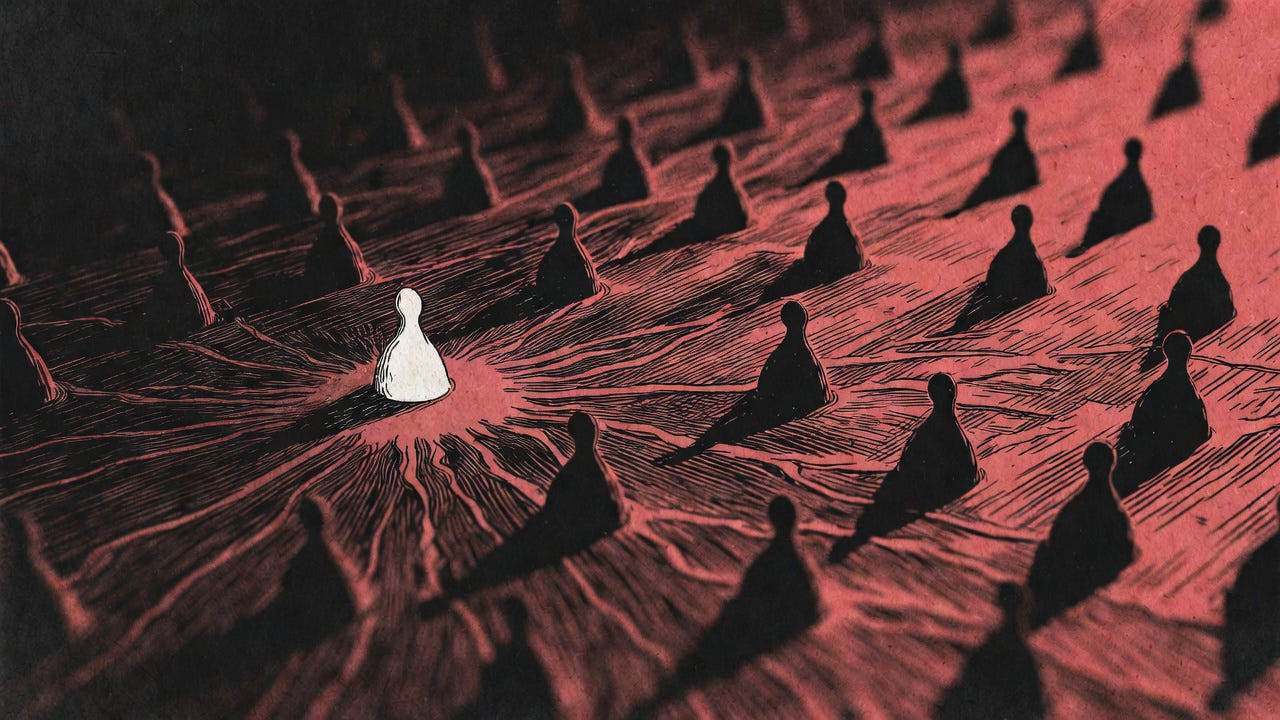
The political internet runs on memes, and I don’t just mean funny pictures. A meme is a packet: an idea compressed small enough to travel. It can be an image, a short clip, a catchy song, a screenshot of a quote, or a phrase. What makes it a meme is the compression. It carries a claim in a form small enough to cross a timeline in two seconds and implant itself in someone’s head.
Richard Dawkins coined the term in 1976, borrowing from genes deliberately, and the analogy holds very well. Like genes, memes evolve via mutation as they carry on and interact with their environments. While they pass through different echo chambers, each person adds something, strips something, or bends the framing to fit their own view. The ones that survive are the ones that spread best in that environment, which is not the same as the ones that are true.
Slogans are the purest case. “Israel killed Charlie Kirk” is a four-word compression of a claim that would take an hour to argue properly. “Free Palestine” compresses an entire political position into two. Neither is an argument. Both are payloads, and both are repeated by people who could not defend them for sixty seconds, which is not a flaw in the design—it is the design.
Attention on social media is measured in seconds, so anything intended to capture attention has to be small enough to do so. An argument can’t do that, but a meme can.
I know how this works because I did it for years.
My most viral meme was a song I made called “Boom Boom Tel Aviv.” It reached hundreds of millions of people around the world because of its catchy lyrics, timed with events that had just occurred. I made it as a joke, but it spread much further than I could have imagined. Another was a Hitler edit set to an already viral Mr. Kitty track. That one is still circulating today, years after I made it, passed around by people who have no idea where it came from.
A viral working meme leaves its author behind. Mine didn’t go away after I abandoned antisemitism. Those pieces reached more people and did more work than any argument I ever wrote, and they did it by being short, catchy, and impossible to counter at the same speed.
My longer “drill instructor” rants traveled for the same reason. The rant wasn’t the meme; it was a delivery vehicle for four or five phrases that were the payload. Everything around them was packaging. The same was true with all of my over-the-top theatrics.
A meme full of disinformation spreads as fast as any other, and usually faster, because it was engineered for spread rather than accuracy: fabricated quotes attributed to famous people; passages from religious texts, invented or stripped of context; and historical claims that were never true.
Memes inside an echo chamber go unchecked because people in it already trust it. They assume that someone upstream verified the information. Usually nobody did. Yet the meme arrives already vouched for by the community it’s traveling through, and that borrowed credibility is what carries it.
A meme is almost always smaller than its refutation. The claim fits in a sentence, whereas the correction needs a paragraph, a source, and context. The first mover sets the frame, and everyone answering it arrives late, carrying more weight. Therefore, a counter-meme has to be as compressed as the thing it’s refuting. If it takes longer to read than the original, it loses, no matter how right it is.
The technique that works is putting the fake next to the real, in one image: the fabricated quote beside the actual text, the cropped photo beside the original, and the out-of-context passage beside the full passage. You don’t have the time and space to argue. You only have the time and space to show the comparison, which the viewer completes on their own.
The same works for footage. 9/11 Truthers always show an edited clip of World Trade Center 7 collapsing that begins at the moment the visible facade drops, which makes it look like a clean demolition. However, the full video shows the east penthouse sinking into the building several seconds earlier: the interior was already failing while the exterior still stood. By the time the outer shell went, there was nothing left inside holding it up, which is why that portion of the fall reaches free-fall acceleration. NIST says so in its own report, and truthers quote that line constantly while cutting the seconds that explain it. The clip supports the demolition theory by starting late. Show the earlier seconds, and you’ve answered it without saying anything.
But no meme stands alone. Each one connects to others, and together they form an ecosystem where every claim supports the neighboring one. Someone in that environment isn’t holding one false belief; they’re holding a web, and each strand carries a foundational assumption that makes the next strand plausible.
Kill one meme and the web holds. The strand regrows because the structure that generated it is untouched. To actually get somewhere, you need a folder of counter-memes, each engineered to cut a specific strand, deployed against the same belief.
Memes behave like viruses. They reach a host, take over how that host sees the world, influence how they act, and then use them to infect the next host. An ecosystem with millions of hosts generates new claims faster than anyone can answer them.
Some people will be infected and stay infected. Others can be cured. The difference isn’t intelligence, and it often isn’t evidence either. The side that reaches more people is the side with better memetics, not the side with better evidence.
Anyone engaged in debunking has to be realistic about that. You’re not going to reach everyone, and treating every failure as your own is how people burn out and quit. All you can do is help counter-memes travel and reach the ones who are able to wake up.
Like medication that needs to be improved to deal with an evolving virus, counter-memes need to evolve too. Whatever works eventually stops working as the other side adapts around it. Engineering one good rebuttal is not enough; you must stay in the loop and keep up with enemy memetics, because the thing you’re fighting is already evolving.