
Platinga's "Proper Function" Is a False Dichotomy

There’s an argument developed by the theist Alvin Plantinga called the Evolutionary Argument Against Naturalism. It claims that if both evolution and naturalism are true, then the probability that our cognitive faculties reliably track truth is low or unknowable. From this, Plantinga argues that trusting our reasoning ultimately requires something like divine design—what he calls “proper function.”
The argument depends on the idea that survival and truth come apart in a deep way. But once you look closely at how learning, feedback, and environmental constraints actually work, that separation begins to break down.
What follows is a demonstration of how reliable reasoning can emerge through interaction with reality itself, without requiring any appeal to divine design.
Lucius: I keep hearing theists say, “If naturalism is true, why trust your reasoning? It’s just particles in motion.” I think that argument has a fundamental flaw.
Geminius: What kind of flaw?
Lucius: It sets up a false choice: either God guarantees truth, or human reasoning collapses. But there’s a third option—reality itself constrains what’s true when we interact with it.
Geminius: Are you thinking of arguments like Alvin Plantinga’s Evolutionary Argument Against Naturalism? The idea that evolution favors survival, not truth, so our beliefs might be unreliable?
Lucius: Exactly. But that argument assumes survival and truth come apart. I don’t think that holds up.
Geminius: Why not? Evolution just needs behavior that works, not necessarily beliefs that are true.
Lucius: But for behavior to reliably work across situations, it has to track real structures in the world. If it didn’t, success would be accidental and unstable, and evolution doesn’t preserve unstable success.
Geminius: So you’re saying truth sneaks in through stability?
Lucius: Not “sneaks in”—it’s built into the process. If an organism consistently misrepresents reality, it will eventually get itself killed. You might get lucky once or twice, but over time, systems that track reality outperform ones that don’t.
Geminius: But couldn’t false beliefs still produce successful behavior?
Lucius: In isolated cases, sure. But across changing environments, false systems break down. To keep producing successful outcomes, your internal model has to line up, at least roughly, with how things actually are.
Geminius: So evolution doesn’t aim at truth directly, but it selects for systems that approximate it?
Lucius: Right. Survival pressures don’t ignore truth; they indirectly select for it through feedback. Bad models fail while better ones persist.
Geminius: Can you give an example of what you mean by feedback filtering out bad models?
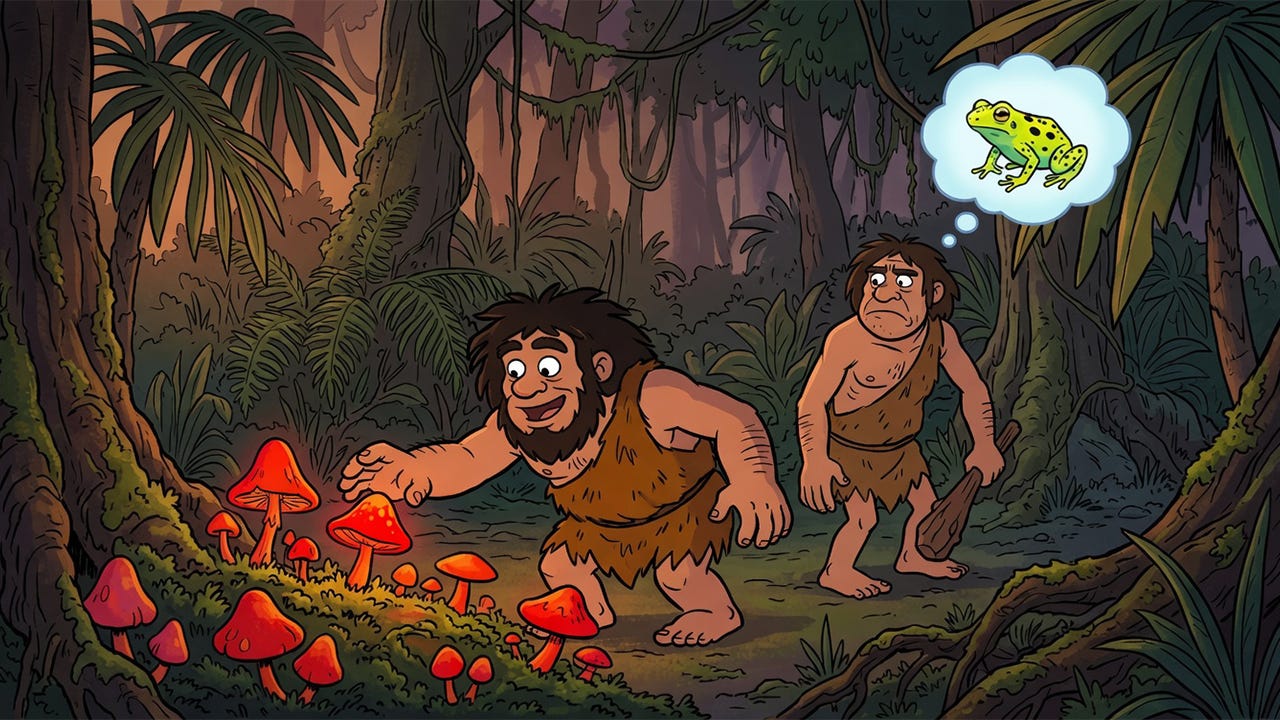
Lucius: Sure. Imagine two early humans—call them Bam Bam and Bom Bom—standing in front of a brightly colored mushroom. Bam Bam looks at it and thinks, beautiful colors, must be good to eat. He has no prior experience with brightly colored things, so he pops it in his mouth and dies within minutes.
Geminius: And Bom Bom?
Lucius: Bom Bom hesitates. He once touched a brilliantly colored frog and broke out in a painful rash for days. He doesn’t have a theory about toxicity—he just has that memory. So he holds back. He watches Bam Bam die. Now Bom Bom and everyone around him know that bright colors can mean danger.
Geminius: So the belief that survives isn’t the prettiest one; it’s the one that tracked something real.
Lucius: Exactly. Reality enforced the correction. No reasoning god required, just a frog, a rash, and a dead friend.
Geminius: But a Plantinga defender would say that their brains were properly functioning, designed by God to form reliable beliefs. Doesn’t that account for why the feedback worked?
Lucius: Run the scenario both ways. With God, with no God: the frog still causes the rash, Bam Bam still dies, and Bom Bom still learns. The feedback mechanism does all the epistemic work either way. Proper function contributes nothing you couldn’t already explain without it.
Geminius: That sounds like a kind of learning process.
Lucius: That’s because it is. It’s trial and error at every level—organisms, brains, even ideas. You act, reality pushes back, and your model gets updated.
Geminius: So reasoning isn’t guaranteed from above; it’s refined from below?
Lucius: Exactly. It’s a feedback loop. Our beliefs aren’t infallible, but they’re corrigible. Over time, interaction with reality filters out the worst errors.
Geminius: And that’s enough to explain why reasoning is generally reliable?
Lucius: Yes. Not perfectly reliable, but reliably improving. You don’t need a divine guarantee, just a stable world and ongoing correction.
Geminius: What about the idea that truth itself depends on usefulness? Are you saying “true” just means “what works”?
Lucius: No. Reality determines what’s true. But our access to truth—our beliefs—gets refined through what works and what fails. Consequences don’t define truth; they help us discover it.
Geminius: And this applies to ideas as well?
Lucius: Definitely. Ideas compete the same way organisms do. Weak ones collapse under scrutiny; stronger ones survive. Not perfectly, but there’s pressure toward coherence and consistency.
Geminius: So in the long run, both evolution and reasoning tend to align us with reality.
Lucius: That’s the point. No divine guarantee—just constraint, feedback, and time. And that’s enough to explain why our reasoning works as well as it does. Plantiga’s “proper function” is just an unverifiable claim that does no epistemic work.