
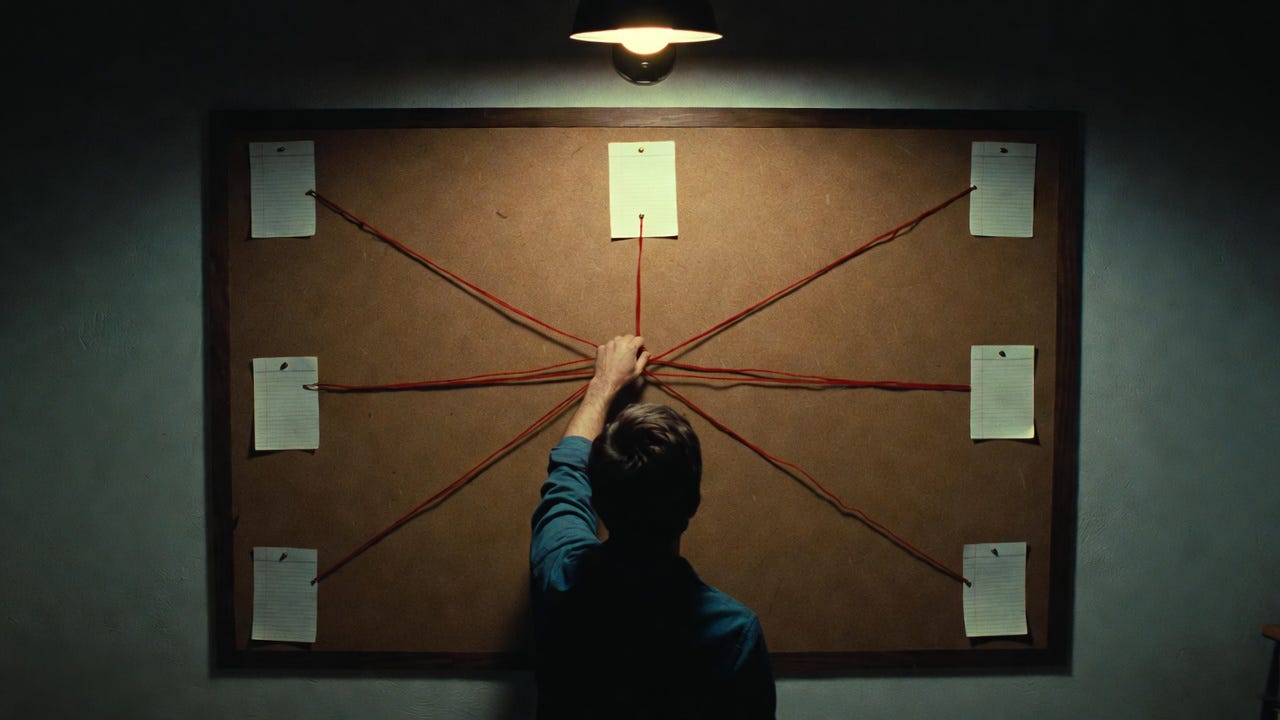
For years I believed 9/11 was an inside job and that Israel was behind it. The pieces broke away slowly, one claim at a time, until a single collapse took down everything that was left.
Doxastic involuntarism—the view that humans do not choose their beliefs—is widely held among epistemologists, including myself. This is why I keep telling people who don’t believe my change is sincere that I had no choice in the matter. Once I was exposed to new information that explained things better than my previous beliefs, especially where those beliefs weren’t factual to begin with, the old ones couldn’t stand.
But how did I get sucked into these beliefs in the first place? Most people don’t fall into conspiracy theories through stupidity; they start with a true observation and then carry it too far.
My journey into the conspiracy theory world started with Operation Iraqi Freedom in 2003. WMDs were the case for the war, but we didn’t find any. I had served my country, only to find out I’d been lied to. I spent the next twenty years ashamed of that service.
Although I was right that my government had lied to me, the big error came next: the distrust that was earned for one narrative spread to all narratives. If they lied to me about Iraq, why believe them about 9/11, or anything else for that matter? Then, why believe any institution that sits near the government at all?
When the Twin Towers collapsed on 9/11, I didn’t study the footage over and over; I saw it once on live television and assumed that was simply how buildings fail. The official explanation was in engineering reports almost nobody read or could read, and I had no reason to go looking. Then in 2006 I watched Loose Change. The narrators told me to notice how fast the towers fell and to look at the “squibs” that seemed like explosives. Suddenly there was a gap between what I’d seen and what I could explain, and I was convinced something was off. The story fit perfectly into a false-flag narrative, carried out by a government that had just lied to me about Iraq.
Two claims carried it over these twenty years. The first was that explosives brought the towers down; I didn’t let that go until 2015, when I went back and was able to debunk each claim, showing that the collapse doesn’t require explosives, and the evidence for them isn’t there. The second was Israeli foreknowledge: the “dancing Israelis,” supposedly positioned in advance to record the attacks, and the Israeli “art students” who supposedly gained access to the buildings to prepare for the operation beforehand. I held on to that until just a few months ago, when I realized the conspiracy theorists who pushed it had misrepresented what the FBI reports actually said and that the Israelis actually warned us about some of the hijackers in August of 2001.
When that second claim fell, something larger fell with it. I realized my antisemitism had exactly the same structure as my 9/11 belief. Coincidences were stacked until they looked like intent, making Jews part of a monolithic conspiracy. Since Jews could not be trusted, just like the US government, no Jewish sources or voices could be taken into account. Every claim against Jews stacked up without any refutation allowed by counter-evidence.
The most recent conspiracy theory we have all seen get created in real time is the “Israel killed Kirk” conspiracy, which takes the same shape as the “Israel did 9/11.” In both cases, Jewish people are named, there’s an appeal to “Cui bono?” and people start making all kinds of claims. Despite knocking down each claim, the conspiracy keeps going. Why? Because refuting a hundred surface claims one at a time is endless; the structure underneath generates new ones faster than they can be answered. But if you show someone the structure, the claims built on it lose their footing all at once.
What is the structure?
Earlier this week, I came up with the idea of mapping out that exact structure using my own experience. By analyzing what happened to me, I identified seven preconditions that had to be in place for me to fall into the conspiracy narrative to begin with.
Distrust: A source lies or fails badly on something that matters, and the person loses trust.
Overgeneralization: The distrust spreads from the claim that earned it to everything the source says and then to anything or anyone associated with that source.
Pattern bias: Other instances of the source lying are noticed, gathered, and read as a rule rather than as a record. The source doesn’t lie sometimes; lying and cover-up become what it does.
Explanatory gap: The event in question has an explanation the person cannot verify for themselves, which leaves them dependent on some other source.
Rival narrative: A competing story fills the gap before the official explanation does. Because it confirms the pattern and seems to explain the event better, it is trusted from the start.
Self-sealing: Credibility is assigned by conclusion rather than by source. Every correction is discounted, and every claim that supports the rival narrative is accepted, even from inside the distrusted institution.
Echo chamber: The community around the belief discredits outside voices in advance and treats doubt from within as betrayal. Questions carry a social cost, so they stop being asked, and the belief is reinforced by the people who share it rather than by the evidence.
Number six is why a conspiracy movement always demands "an independent investigation" and rallies behind every so-called whistleblower. Its members have cut off every channel that could correct them and ask for a new one they'd accept—one that doesn't exist and, by construction, never will. The seventh is why that demand is rarely questioned from inside: the people who might question it have learned what it costs.
Since we can’t choose our beliefs, peer pressure alone doesn’t work. You can’t force someone into letting go of something any more than you can force them to accept something. The only thing that works is changing what the person can see.
The most useful question I know to ask someone is this: What would it take to change your mind? Most of the time they will give you exactly what it takes. But if their answer is “nothing,” or a condition that could never be met, that means the belief has been walled off from anything that could defeat it.
Often the wall is the cost of leaving the tribe. Picture a religious leader, whether a rabbi, a priest, or an imam, thirty years into his ministry, who hears an argument he can’t answer. Conceding it would cost him more than a belief; it would cost him his congregation, his standing, his livelihood, and the self he has spent three decades becoming. The same holds for anyone who has built an identity, an audience, or an income on a conspiracy. That is why an argument can land and still change nothing.
Epistemologists have long recognized two basic ways to check a belief. You can check whether it coheres, meaning it’s consistent, follows its own rules, and doesn’t contradict itself. Or you can check it against the world through tests, predictions, and results that other people can repeat and arrive at independently—science. The first settles matters that live inside a system, like mathematics or the rules of a game. But any claim about what actually happened in the world needs the second, and no amount of the first can stand in for it.
A conspiracy theory passes the first check. Ironically, it’s often more coherent than reality, which is why it seems to explain things better and feeds the pattern bias so well. Reality is messy, full of accidents and failures that don’t add up to anyone’s plan. However, a conspiracy theory fails the second check, and the distrust has already severed the channel through which the second check works, namely other people converging on the same answer. What remains is a claim about the world held up entirely by internal consistency. But internal consistency does not mean matching to the real world.
Real conspiracies exist, but there’s a line between real and imagined ones. COINTELPRO was real. MKUltra was real. The Tuskegee study was real. The Bush administration made the case for war in Iraq based on claims its own intelligence didn’t support. We know about these because documents surfaced, independent investigators converged, and the evidence held up when other people checked it, not because each narrative was coherent.
There’s nothing wrong with being skeptical or distrusting one’s government or anyone else for that matter. But trust isn’t all or nothing. A source that lied about one thing can be right about another, and the only way to ever know is to check, claim by claim.
Beliefs that ask you to stop checking are the ones to watch.
9/11 Cui bono? 🇮🇱
9/11 Cui bono runners-up? Cokehead Warmonger and 🇺🇸 war machine
9/11 Dishonorable Mention: "Lucky" Larry Silverstein
Great article, man. It's rather upsetting that social media is doing nothing to fact-check and community-note these lies. Good to have someone of your stature and intelligence in the fight. Semper Fi! 🫡