
The Media Matrix That Makes You Forget

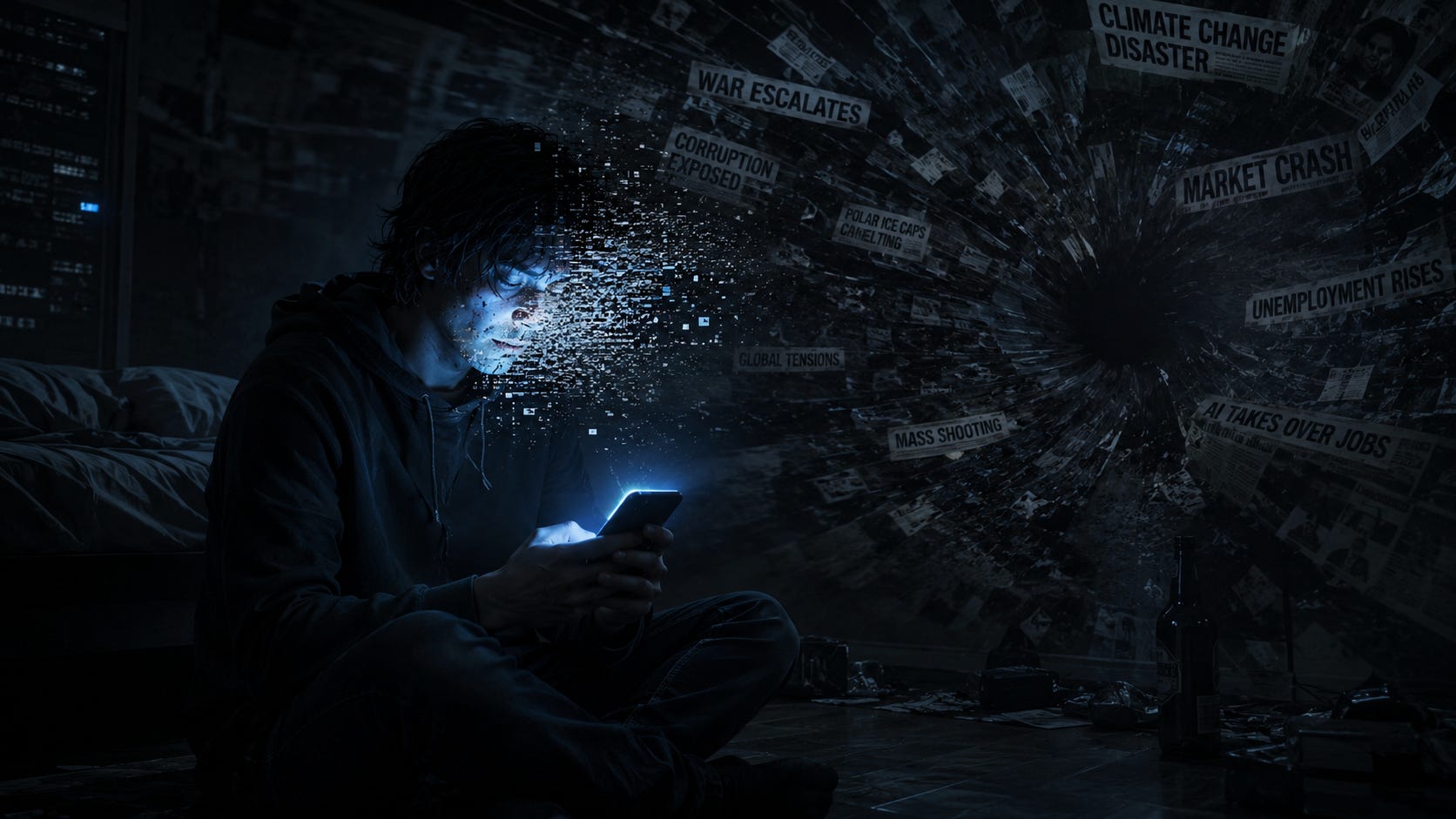
Two weeks ago, something happened. Something that would have dominated headlines for a month in 2005. Something people would have talked about at dinner, argued about at work, and processed over time.
But you can’t remember what it was. Can you? That’s not a memory problem. That’s what I’ve noticed is happening to everyone due to several factors I was just pondering about and decided to write down here.
We’re living inside a matrix that produces forgetting—not accidentally, but structurally. The same algorithm that feeds you the next story needs you to get over the last one. Even outrage has a shelf life now, measured in hours and days. The news cycle doesn’t just move fast; it actively buries what came before it. Every new story is a shovel. We feed this machine because we’re addicted to the cycle of novelty it produces every day.
The attention economy runs on dopamine. Every scroll, every notification, every breaking headline triggers a small hit. Like any drug, your brain starts requiring more to feel the same thing. So the stories have to get bigger, louder, and more extreme to keep you sucked in. A mass shooting registers as a blip. A genocide being filmed in real time—actual human beings recording their children being bombed and sending it to your phone—becomes background noise within weeks. Not because people are monsters, but because the system has conditioned the response out of us.
This is what psychologists call psychic numbing. Your mind has a circuit breaker. When the horror exceeds what you can process, it distances itself. It has to. I noticed this happen to me after two years of seeing Palestinian children being blown to pieces. The problem is that the circuit breaker was designed for discrete catastrophes—a war, a disaster, or a personal loss. It was not designed for a continuous feed of catastrophes delivered simultaneously to a device you carry in your pocket.
We are running trauma-response software on hardware that was never built for it.
And now it’s affecting how we think about the unthinkable. This numbing is real, and it’s getting worse. And this is also affecting our memory. Things that used to shock us, such as a school shooting, are just another day in America.
People talk about World War III like it’s a sports prediction. You can place bets on Polymarket about potential airstrikes on Iran. The Russia/Ukraine war has become ambient noise—still happening, people still dying, just not interesting enough to trend. The mosque shooting yesterday. I saw it. You probably did too. And if you’re honest, it landed differently than it would have ten years ago. Not because you don’t care, but because you’ve become used to such things.
There’s an observation about China—there are so many people, life isn’t as precious. The scale degrades the value of the individual. We’ve done that to ourselves globally. We’ve created a civilization-scale version of that dynamic through technology. Seven billion people’s suffering, compressed and delivered in a feed, and the denominator is so large that each numerator approaches zero emotionally.
Ironically, the technology that connected us has disconnected us faster than anything in human history. We have more access to each other’s reality than any generation ever has, and yet we are more numb to it. Simultaneous exposure is not the same thing as connection. Watching the same feed alone in your room is not community.
Real connection requires sustained attention and investment. It requires processing. It requires sitting with something long enough for it to actually land.
The feed was designed to prevent that. Because processing is slow. Sitting with something doesn’t generate clicks. So we consume everything and are moved by nothing long enough to act.
The memory-holing is just the output. It’s the evidence that the system is working exactly as designed. We can’t hold power accountable for what we can’t remember. We can’t build a collective response to what we’ve already scrolled past. We can’t grieve what we consumed in three seconds between two other things.
The architecture of our information environment is producing a specific kind of person—not hardened, not cynical exactly, but hollowed. Capable of registering everything, but less capable of being moved by things that should matter.
We’ve entered a new phase of the information age. It’s dumbing us down, stripping us of our humanity, and we'll probably forget I wrote this by next week.
Yes, you’re right it just becomes another event. Far away that we can’t do anything about it. Peoples lives shattered & destroyed & it probably will happen to us. You get numb. Bless