
The Plausibility Scale

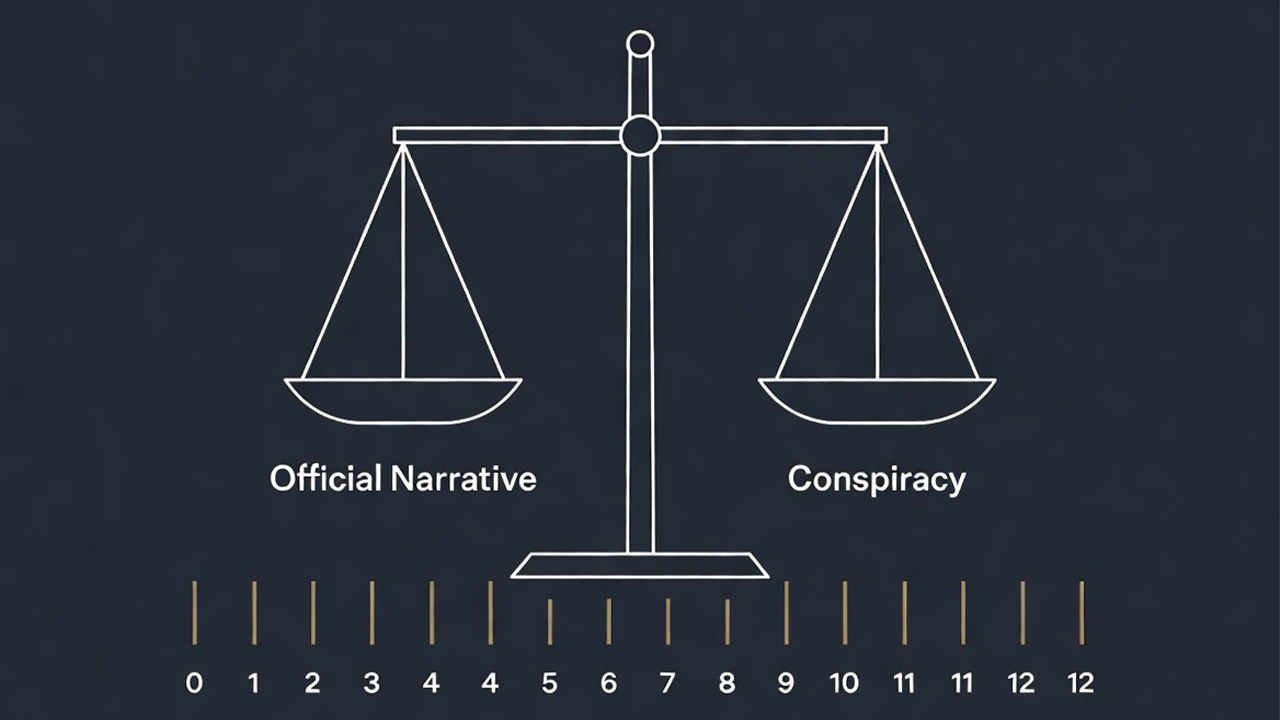
Carl Sagan’s maxim—“Extraordinary claims require extraordinary evidence”—is one of the most quoted lines in skeptic culture. It feels decisive and rational, and it’s constantly used in arguments about conspiracy theories, psuedoscience, and contested historical events. But here’s the problem: it doesn’t actually tell you anything.
What makes a claim extraordinary? How much evidence is extraordinary enough to offset it? How do you compare two competing extraordinary claims against each other? The maxim gives you the vibe of critical thinking without the machinery of it.
Skeptics deserve better than that.
When you encounter a conspiracy theory, a disputed historical event, or an official narrative that doesn’t quite add up, you need a way to evaluate it before you’ve gathered all the evidence, because evidence is often incomplete, contested, or deliberately buried.
The first question is usually “What does the evidence say?” I think we need to start with “Is this claim even worth taking seriously as a live possibility?”
That question requires a different tool. Not Bayesian updating, which tells you how evidence should change your mind, but something more fundamental: a structural plausibility check that asks how much the architecture of a claim costs before a single piece of evidence is introduced.
My insight is simple: every narrative requires certain structural inputs to be true. It needs actors with reasons to act, the capability to execute, and a sequence of events that doesn’t rely on an improbable run of luck. The more of those inputs a narrative requires, and the more improbable each one is, the higher the evidentiary bar should be before you take it seriously.
This isn’t a dismissal tool. It’s a triage tool. It tells you where to allocate your investigative credence before the evidence comes in.
The Three Dimensions
After thinking through what makes a narrative structurally costly, three dimensions emerged as fundamental for any claim involving human action:
1. Motive: Does anyone have a coherent reason to do this?
Not “could someone theoretically want this?” but “is there a plausible, precedented reason a real actor in this situation would take this action?” The weaker the motive, the more work the rest of the narrative has to do.
2. Capability: Could anyone actually pull this off?
This covers resources, expertise, and the number of cooperating parties required. A plan that requires thousands of people to stay silent indefinitely, or resources no known actor possesses, or technical capabilities beyond what’s been demonstrated—these are not impossible, but they are expensive in structural terms.
3. Coincidence: How much luck does this need?
Every independent unlikely event a narrative requires is a multiplier against it. One fortunate coincidence is normal. Two is notable. But a long chain of independent improbable events—each individually possible but all needing to align—compounds into something that approaches structural impossibility regardless of the topic.
How to Use It
Every contested claim is weighed across three dimensions, scored 0 to 4 each:
Motive (0–4)
0: No conceivable motive; the action would actively harm every plausible interest of the actor
1: A motive is theoretically imaginable but requires unusual values or circumstances
2: A plausible motive exists but is speculative, inferred rather than evidenced
3: A clear, well-precedented motive consistent with how this type of actor behaves
4: An obvious, strong motive you’d expect as a default explanation
Capability (0–4)
0: Requires resources or coordination no known actor possesses
1: Theoretically within reach but would require extraordinary effort beyond demonstrated capacity
2: Plausible but demanding—would stretch resources or require nontrivial coordination
3: Comfortably within known capabilities with modest coordination
4: Trivial—minimal resources, achievable by a small group with no special capability
Coincidence (0–4)
0: Requires a long chain of independent improbable events compounding to near-impossibility
1: Requires several independent unlikely events to align
2: Requires one notably unlikely event, or a couple of mildly unlikely ones
3: Requires at most one mildly fortuitous circumstance within normal variance
4: Requires no coincidence at all—the sequence is exactly what you’d expect
The maximum score is 12. The lower the total, the more structural weight you’re asking evidence to overcome before the claim deserves serious credence.
Comparative and Bidirectional
You don’t weigh a claim in isolation; you weigh it against other narratives.
Take Flat Earth. There are two competing narratives:
Narrative A: Standard cosmology is accurate.
Motive: 4 (scientific institutions have every reason to accurately map reality for navigation, engineering, physics)
Capability: 4 (basic observation, independent verification by thousands of uncoordinated actors globally)
Coincidence: 4 (no improbable luck required—independent measurements converge as expected)
Total score: 12/12
Narrative B: NASA and every space agency are lying.
Motive: 1 (what exactly is the endgame, and why would Roscosmos and JAXA cooperate with NASA on it?)
Capability: 0 (requires tens of thousands of scientists, pilots, sailors, engineers, and amateur astronomers across every nation and ideology to maintain a consistent deception indefinitely)
Coincidence: 0 (requires GPS systems, satellite internet, aviation routing, and independent telescope observations to all accidentally corroborate the lie)
Total: 1/12
We’re not dismissing Narrative B as impossible. But as you can see, the structural cost of Narrative B is so high that it would require extraordinary evidence to overcome. Not because someone told you to be skeptical, but because you can see exactly what those costs are.
This tool’s neutrality is its most important feature. The same structural accounting that deflates low-quality conspiracy theories also flags something important: when an official narrative relies on an unusual run of coincidences, that’s worth noting too.
For example, 9/11—a passport surviving a jet-fuel inferno and being recovered intact a few blocks away—is a specific event. Score it honestly on the coincidence dimension. You don’t have to conclude anything that the framework doesn’t conclude for you. But you’re entitled to notice that a narrative requiring that event be taken at face value is carrying structural cost, and that cost should be acknowledged rather than waived.
This is what genuine skepticism looks like: applying the same structural scrutiny to all competing accounts, not just the ones that challenge official positions.
What This Doesn’t Do
This scale doesn’t tell you what’s true. A low structural score doesn’t mean a claim is false—complex, lucky things do happen. Evolution is statistically staggering in hindsight, yet here we are. Many true historical events would have scored poorly on a pre-evidential plausibility check, but they happened. The universe is under no obligation to produce only probable outcomes. In fact, it’s mathematically inevitable such outcomes will occur.
What this tool does is tell you how much evidential weight you’d need to rationally shift your credence toward a low-scoring claim. A narrative scoring 2/12 isn’t dismissed; it’s just placed in the category of “this needs commensurate evidence before I invest real credence in it.”
Why This Matters Now
We live in an information age where narratives compete for credence at a speed that makes careful evaluation nearly impossible. The default responses to this—“just trust the experts” or “do your own research”—are both intellectually bankrupt. One outsources your reasoning entirely; the other usually means cherry-picking confirmation without any structural check on what you’re selecting.
What’s missing is a simple, honest, bidirectional tool for evaluating the architecture of a claim before the evidence war begins. Just three questions, scored honestly, applied to every competing narrative equally.
Motive. Capability. Coincidence.
If a story needs all three in abundance and scores poorly on all three, Sagan’s maxim finally has some machinery behind it. And if an official story is carrying more structural cost than it’s been made to answer for, you’ll see that too.
That’s what genuine skepticism actually looks like.