
We need to bring back national pride in America. The problem is most people no longer agree on what there is to be proud of.
What I learned in the Marine Corps is that a group with every difference you can name—race, religion, region, class, education—can function as one unit if it shares a mission. My unit had men who would have had nothing in common on the outside and would probably have disliked each other on sight. But inside, none of it mattered, because we had the same objective, the same standards, and the same consequences for failing them. Although our differences weren’t erased, they were made irrelevant by something larger that unified us.
America doesn’t have that anymore. What Americans are told is that the objective is yourself. Maximize your income, optimize your life, and treat the country as the place where you happen to be doing it. When the mission is the self, your countrymen aren’t your unit; they’re your competition.
Individualism alone isn’t the problem; it’s a hyper-individualism stacked with hyper-materalism. This is already corrosive in a homogeneous country. In a diverse one, it’s extremely detrimental, because now you don’t have individuals competing against each other, which a healthy country can absorb and even benefit from. You have groups competing, each with its own history, grievances, and sense of who counts as “us.” Political disagreement is already hard enough to hold a nation together. Add religion, race, ethnicity, language, and culture on top of it, with no shared mission underneath, and the fractures run all the way down.
This isn’t unique to America. It’s true of any nation on earth. What’s unique is that Western countries were talked into treating the problem as imaginary and into treating anyone who noticed it as a racist.
So what’s the shared mission objective supposed to be?
We can’t unify around race. There are too many, and the moment one group takes pride in itself, especially White people, another hears a threat. We can’t unify around religion for the same reason. What’s left is culture, and when people try to name American culture, they usually come up with holidays, baseball, hamburgers, and freedom. That’s not nothing, but it won’t hold a country together, and plenty of new arrivals don’t identify with any of it. Many have been taught that the founders were colonists and racists, and our history was just hate and genocide, which means the one inheritance that could be shared has been poisoned before anyone gets to it.
A nation whose citizens take no pride in its history has no reason to preserve itself. Nothing gets maintained that nobody values. And that’s what the last few decades look like.
Here’s what I think the shared pride actually needs to be in order for us to survive.
America is a country where the basis of membership is a creed rather than a bloodline. Equality before the law. Free speech, including speech you hate. Due process. Self-government. The right to be left alone by those in power. These are demanding commitments; most of the world has never managed them, and we have managed them better and longer than anyone.
But the creed isn’t the thing to be proud of. The process of living up to it is.
I’ll use my experience going to boot camp to make my point.
Nobody is born a Marine. You arrive at boot camp with whatever you came with—your town, your race, your religion, your father’s name—and none of it matters. What follows is a process to break down your identity: the shaved head, the uniform, the micromanaging, the high standards nobody lowers for you, and the shared misery. All of it strips away your individuality to make you part of a unit.
After three months of brutal physical and mental torture, you’re handed the title of “US Marine,” and it means something precisely because everyone in that room earned it on identical terms.
That’s where American pride belongs. Not in the status, but in the process that produces it. In becoming an American rather than merely being one. In upholding the values despite the differences, which is work rather than an attribute. In defending the country and contributing to it.
Pride in your race or in the religion you were born into is pride in an accident. You accomplished nothing. You were handed a result and told to feel proud of it. But pride in a process is the opposite on both counts: you have to do something to get it, and anyone willing to do the same thing can have it. That’s a higher form of pride, and it’s the only kind that can hold a country this diverse together.
It also makes a demand the other kind doesn’t. If pride comes from the process, then being born here doesn’t finish the job. You can be a citizen by accident and an American by effort, and plenty of people born here have never done the second part.
But a process only works if it’s actually run like a machine.
My great-grandfather, Vincenzo Gagliardi, came here in the 1800s, served in the Marine Corps, and fought in the Spanish-American War. His last name was truncated to “Gage” to assimilate into American society. My grandfather, Angelo Gage, served in the Air Force during the Korean War. I served two tours in Iraq.
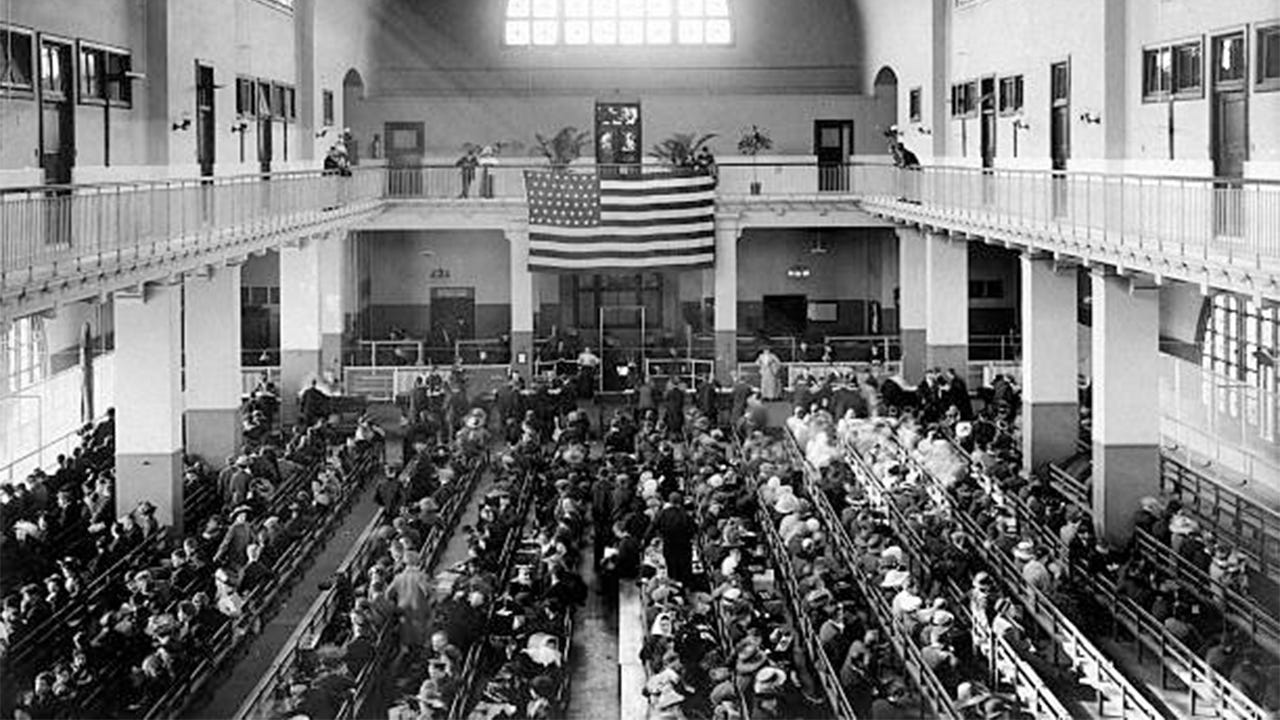
Let’s not forget that Italians were not considered the same as the people already here. In 1891, eleven Italians were lynched in New Orleans, and respectable newspapers defended it. Government commissions sorted European immigrants into separate races and ranked them, with Italians near the bottom. The 1924 immigration law was written specifically to reduce arrivals from Italy and Eastern Europe on the argument that those people were incapable of self-government and would never become Americans.
They were wrong.
Not because people are interchangeable, but because the machine worked, and the machine was real: a long pause in mass immigration that gave the existing waves time to be absorbed, public schools that taught American history as something to inherit rather than apologize for, military service that threw men from everywhere into the same unit, economic mobility that made the next generation middle-class, intermarriage, and a culture confident enough to demand assimilation.
My family didn’t ask to be accommodated. Nobody changed anything for us. We changed, which is why I’m not writing this under the name Gagliardi.
Every part of that American-making machine has since been switched off.
The pause ended in 1965 and never came back, so the foreign-born share of the population has run at or near its historical peak for years. Immigration policy stopped selecting for assimilability and started selecting for almost nothing. Civics instruction collapsed, and what replaced it teaches the founding of our country as a tragedy. The expectation of English went with it: the Bilingual Education Act of 1968 shifted federal policy from teaching English to maintaining the student’s native language and culture. And the receiving culture lost its nerve, since asking anyone to adopt American norms became “racist.”
Nobody gets through boot camp without being changed. That’s the difference between a process and a door.
Now we have a door that’s been kicked off its hinges and left wide open. We removed the requirement to learn the language. We removed the shared history because the schools stopped teaching it as an inheritance. We removed the expectation itself, because asking anyone to adopt American norms became White supremacy.
What’s left is access to the benefits of a country without ever becoming a countryman.
America has become a nation that you extract from rather than join. Can we blame the migrants? Not really. Our government no longer upholds the standards needed to keep our country a country. That isn’t a statement about any nationality. Put the same arrangement in front of any population on earth and you’d get the same result.
Suppose a hundred million Italians arrived tomorrow—people from the same stock as my own family, all of them willing to assimilate. There would be nobody left to assimilate to. Little Italy becomes the whole country, and whatever you’d call the result—it isn’t America. The point isn’t the Italians; it’s that absorption has a rate, and a culture can only transmit itself to as many people at once as its institutions can reach.
So what I’d argue for isn’t bolting the door shut forever. I’m an immigrant’s descendant, and I wouldn’t be here to write this if that happened. It’s restoring the conditions under which the door works: numbers that institutions can actually absorb, selection for people who actually want to become Americans rather than extract from Americans, English required rather than optional, a history taught as an inheritance, and a culture where assimilation is a requirement, not an option.
Newcomers can add positively to America. Italian food and Italian names became American without anyone rewriting the Constitution, and that’s the correct relationship—you bring what you have into an existing structure, and the structure holds.
I don’t want George Washington reinterpreted to look like me. I don’t want the founders demoted to make anyone comfortable. I want what every assimilated immigrant family in this country once wanted, which was to belong to something that already existed and was worth belonging to.
If we can unite around that—a pride earned rather than inherited, strong enough to make our differences irrelevant the way my unit did—then the diversity here doesn’t have to be fatal. We are strong enough to absorb it if we do it correctly. But if we don’t, it won’t be a military invasion that ends this country. It will be the melting pot melting us away, which is what’s been happening for a while now.
Nailed it Lucas. America dissolved after the draft dissolved. It would be the most unpopular political position in history but if we required every American to serve for at least one year we'd have a lot less wars and a lot more pride.
There is no convincing argument for the "Economic Zone" vs. nationhood.
1920s American immigration was organic and European, so it worked.
Everything after that--1965 immigration laws, Reagan scamnesty, Bush41's 1990 overhaul--was planned to the detriment of White Americans, just like the refugee scams.