
What is "PIE"?

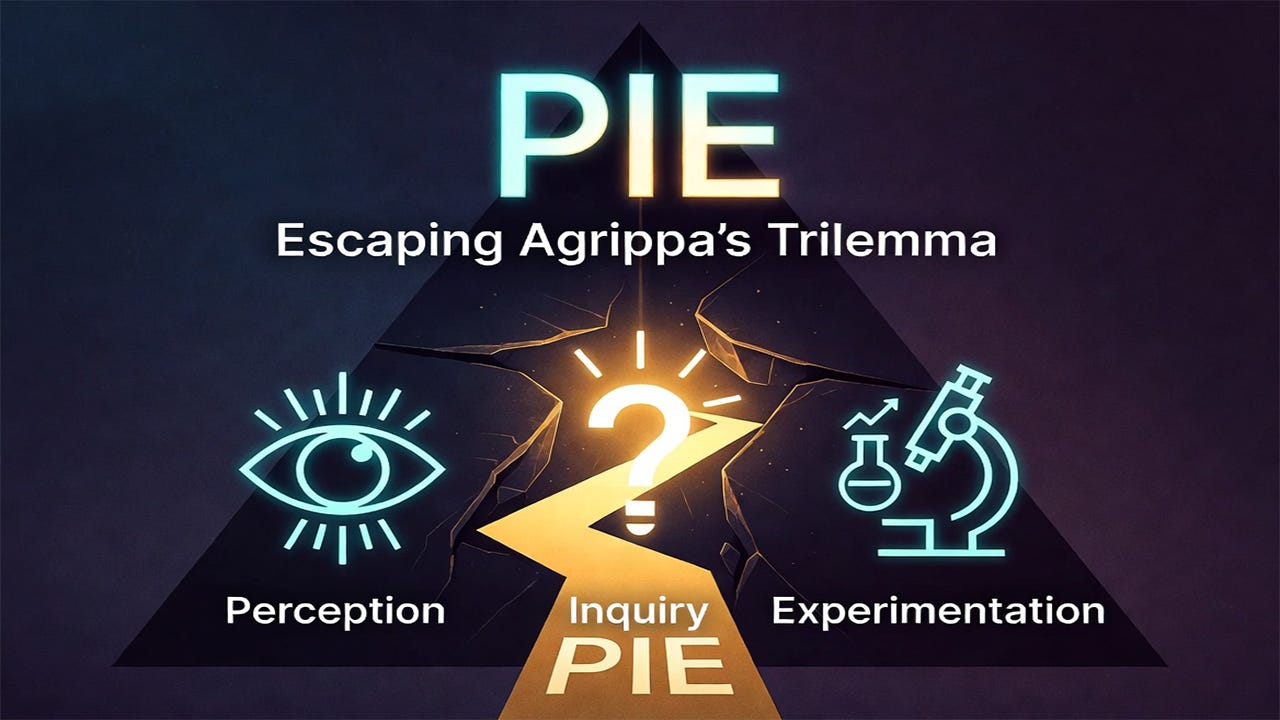
This article has one goal: to put PIE—the epistemological framework I’ve been building and defending that’s currently under peer review—in front of you in plain language.
Since PIE started circulating, it has drawn plenty of reactions: some are thoughtful, while most are dismissive. The most disingenuous attack is that it’s “AI slop,” coming from many of my detractors, which is demonstrably false. This is why no one, at any time, gave the only response that actually counts in philosophy: engagement with the argument itself. They make false claims about me and my work, then pretend that it refutes what I’ve created.
It doesn’t.
I created PIE in October of 2025. “PIE” is an acronym for the steps we humans take to justify any of our beliefs at all: perception, inquiry, and experimentation. Its first iteration was a five-premise meta-epistemological description, but I later realized I could turn it into a seven-premise transcendental argument—an argument that shows what must be the case for a thing to be possible.
Everyone knows I use AI to assist me in my work. I use it openly as a research tool, the way earlier generations used libraries, correspondence, and assistants. Instead of typing my work, I’ve been dictating everything, now that voice-to-text is nearly impeccable. I dictate my ideas and arguments and then direct Claude to draft papers, like a director guiding a movie set. I disclose my method when I submit work to academic journals, which accept AI assistance so long as you are the author.
If PIE is “AI slop,” then it should be easy to prove it. But first, you need to know what problem PIE was designed to deal with, because it’s one of the oldest in all of philosophy.
Somewhere around the first century BC, a skeptic named Agrippa built a trap that philosophy has never gotten out of.
It works like this: take anything you believe—anything at all—like that the earth orbits the sun, that your mother loves you, or that 2+2=4. Now ask the simplest question: how do you know?
Whatever answer you give, I can ask again: and how do you know that?
There are only three ways this game can end, and all three are bad:
You stop somewhere. At some point you plant your flag and say, “This I just know—no further justification needed.” But why stop there? Stopping is arbitrary. You haven’t justified your belief; you’ve just gotten tired of the question. The skeptics called this dogmatism/arbitrariness.
You never stop. Every answer gets supported by another answer, forever. But an infinite chain of reasons is a chain no finite mind can ever complete, which means the justification never actually arrives. This is the infinite regress.
You loop back. Eventually your reasons start supporting each other: A because B, B because C, C because... A. But a circle of beliefs holding each other up doesn’t justify anything. This is circularity.
Dogmatism/arbitrariness, infinite regress, or circularity are the three horns of Agrippa’s trilemma. The uncomfortable truth is that 2,300 years of Western epistemology have mostly consisted of philosophers choosing which horn to impale themselves on to deal with the trilemma but never finding a way to resolve it. Foundationalists chose dogmatism and tried to find stopping points that don’t feel arbitrary. Coherentists chose the circle and argued that big enough circles are respectable. Infinitists chose the regress and made peace with it.
None of these defeat Agrippa.
I designed PIE to avoid all three horns. The key word here is “avoid”—the trilemma cannot be defeated because it’s a true boundry. However, like any boundary, you can get around it, which is what I figured out how to do.
How?
The trilemma assumes that justification is a relationship between propositions. Belief A is justified by proposition B, which is justified by proposition C, and so on. Once you accept that, you’re stuck: any chain of propositions must stop (dogmatism), continue forever (regress), or bend back on itself (circle). Those genuinely are the only three shapes a chain can take.
The trilemma isn’t wrong about chains, but it’s wrong that justification will always lead to such chains.
I asked myself, “Is there a way to justify propositions without other propositions?”
That question led me to find an answer, and the answer is PIE.
Now, let me explain to you how.
Start at the most fundamental. Not with a belief, but with something underneath belief.
Your awareness.
Right now, reading this, there’s awareness happening. Can that be doubted? Try it. Formulate the doubt: “Maybe there is no awareness.” Who’s formulating? The doubt is an act of awareness. Denying awareness is like shouting, “I am silent”—the performance refutes the content.
Notice what just happened, because it’s the keystone of everything that follows. Awareness didn’t get justified by another proposition. It got vindicated by the act of challenging it. That’s a kind of grounding Agrippa’s trilemma can’t touch, because this isn’t a statement supporting a statement; it’s a precondition showing itself in any statement whatsoever. The regress can’t start here, because there’s no inference to interrogate. The stopping point isn’t arbitrary, because it isn’t chosen; it’s forced by the structure of the challenge itself. And there’s no circle, because nothing is being derived from anything.
Here’s the PIE Syllogism in full—each premise in its formal dress, followed by a plain-English translation, so those of you who are not philosophers can understand it.
P1. Finite agents operate from subjective awareness.
Translation: we all operate from our mind’s unique point of view. Try denying this one—the denial happens inside your awareness, refuting itself as it’s spoken.
P2. Epistemic instability within awareness undermines warrant.
Translation: a mind holding contradictions hasn’t settled anything. Unresolved conflict just is the absence of warrant (justification for knowledge).
P3. Resolving epistemic instability within awareness necessitates coherence among representations.
Translation: fixing the conflict means making your representations (thoughts/ideas) consistent, not because someone chose that method, but because that’s what “resolved” means. Even suspending judgment is a move to protect consistency.
P4. Coherence among representations constitutes Justified Coherent Belief for intrinsic claims.
Translation: for claims that live entirely inside representational systems—math, logic, definitions—coherence is the game, because there’s nothing outside the system to check.
P5. Extrinsic claims require world-directed verification beyond internal coherence.
Translation: claims about the world need more than a coherent story. A conspiracy theory can be perfectly consistent, but consistency alone can’t confirm reality.
P6. Because attempts at truth-correspondence verification of mind-independent reality generate regress, circularity, or arbitrary stipulation, classical Justified True Belief is structurally inaccessible.
Translation: you can’t step outside your own representations to check them against raw reality—every check is another representation. So “verified correspondence with reality” is structurally unavailable to any finite mind. This is where Agrippa was right.
P7. Extrinsic claims must therefore resolve through fallible empirical experimentation and intersubjective convergence, constituting Justified Reliable Belief.
Translation: what’s left is testing beliefs against the world and against other inquirers, keeping what survives, and correcting what doesn’t. Not certainty earned, but revisable reliability. In other words, science.
C. Justified Coherent Belief and Justified Reliable Belief are the non-arbitrary warrant structures available to finite agents.
Translation: two ways to warrant a belief. That’s the full inventory for creatures like us, and neither one is touched by Agrippa’s horns.
P1 is anchored the hard way: denying it self-refutes in the act, the moment the denial is uttered. P2 through P7 are anchored by structural arguments: denying them doesn’t collapse in the utterance; it collapses under examination when you try to make good on the denial and find it costs you regress, arbitrariness, or incoherence. Those are two different strengths of necessity; the argument uses both.
So the challenge stands, and it’s specific: not “I don’t like this,” not “Lucas is an idiot,” not “AI wrote it.” Which premise is false, and what’s your demonstration? It has been on the table for months; thousands of philosophers have read my papers on Academia and PhilPapers, and hundreds of debate bros on Twitter have attacked it, and none have refuted a single premise.
The full version is currently under peer review at Logos and Episteme; the framework is documented on PhilPapers for anyone who wants to read the entire paper.