
Why Mussolini Has a Grave and Hitler Doesn’t

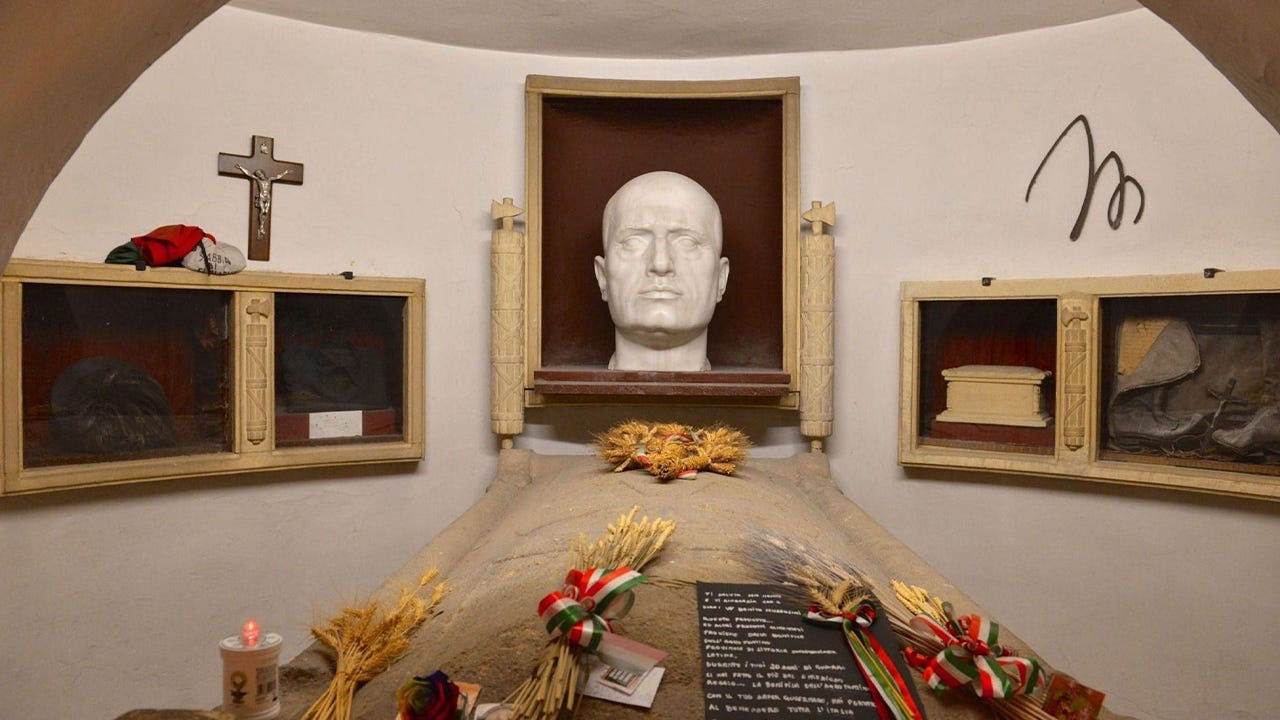
Tens of thousands of Italians make the trip to Mussolini’s hometown in Predappio, Italy, every year, where he’s buried in a crypt maintained by his family. But nobody visits Hitler’s grave because there isn’t one. His remains were destroyed by Soviet authorities and later German officials, precisely to prevent a shrine from forming.
Mussolini isn’t condemned as much as Hitler. There are barely any documentaries on him. The History Channel has jokingly been called “The Hitler Channel” for how much time it spends discussing Hitler and Nazism. Jewish organizations spend a lot of time warning us about Nazis and Hitlers. Yet for Mussolini, there’s virtually nothing despite being Hitler’s ally in WWII.
This tells us something real about the difference between these two men, these two regimes, and how history ultimately judges them.
They Weren’t the Same Kind of Fascist
The easy habit is to lump Mussolini and Hitler together—two fascist dictators, same era, same alliance, same moral category. The word “fascist” is thrown around as a pejorative more than anything else. Most people have no idea what Mussolini’s fascism actually was; they just think it’s “bad” because “fascism is bad.”
But there’s a huge difference between Italian Fascism and German National Socialism.
Mussolini came first. He built Italian Fascism around national power, Roman revival, and the corporate state. Race wasn’t part of it. For the first sixteen years of his rule, from 1922 to 1938, Italian Jews faced no persecution. In fact, many were members of the Fascist Party. Some were prominent. Mussolini, who was a womanizer, had a Jewish mistress, Margherita Sarfatti. In fact, in the early 1930s, Mussolini openly mocked Nazi racial theory as pseudoscience.
Hitler, however, built National Socialism around racial theory from the beginning. The Holocaust was an inevitable consequence of a program designed to preserve Germany’s racial purity, with Jews being the main enemy of the Reich.
So how did these two different men with different ideologies become allies in WWII?
Ethiopia Changed Everything
Before 1935, Mussolini was aligned against Hitler. He was part of the Stresa Front, a bloc with Britain and France designed to contain German expansionism. When the Nazis attempted a coup in Austria in 1934, Mussolini mobilized Italian troops to the Brenner Pass. He was, in effect, the thing standing between Hitler and his first territorial grab.
Then Italy Ethiopia invaded in 1935. The League of Nations condemned it, imposed sanctions, and isolated Italy diplomatically. The Western powers who had been Mussolini’s partners turned on him. With nowhere else to go, he drifted toward the one major power that wasn’t condemning him: Germany. The Axis wasn’t an expression of natural ideological kinship. It was mostly a product of diplomatic isolation. Mussolini got shoved into Hitler’s arms.
Il Duce’s speeches from this period are telling. During a speech at Bari, Italy, Mussolini essentially ridiculed the Germans, contrasting Italy’s rich inheritance of art, music, literature, and the Roman Empire with what Germany had to offer. This wasn’t a man who saw Hitler as a kindred spirit. He saw him as a junior partner, an upstart borrowing from Italian Fascism’s playbook. Likewise, Hitler didn’t have nice things to say about Italians. In Mein Kampf, he basically expressed his view that Italians are a racially mixed, Mediterranean people who squandered the Nordic blood that once made Rome great.
Although Hitler and Mussolini did respect each other, the relationship inverted completely over time. By 1943, Mussolini was a dependent client propped up by German troops after his own Fascist Grand Council voted him out. The man who had stared Hitler down over Austria ended up hanging from a gas station in Milan under German protection.
Italian Racism and Antisemitism
In 1938, Mussolini introduced racial laws stripping Italian Jews of citizenship and barring them from schools, professions, and mixed marriages. But most historians read these laws as largely political signaling—a gesture of solidarity with Germany at the moment the formal alliance was being cemented—rather than the expression of a deeply held antisemitic worldview. This is supported by the fact that enforcement was inconsistent. Italian officials, clergy, and ordinary citizens frequently helped Jews evade the laws.
When Germany occupied northern Italy after 1943 and began deporting Jews, Italian soldiers in occupied France and Greece had been known to actively protect Jews from Nazi roundups, sometimes defying direct German orders. Around 8,000 Italian Jews were ultimately deported and killed.
This is probably why Mussolini isn’t condemned as much as Hitler.
The War Was His Worst Decision
Italy entered World War II in June 1940, when France was already collapsing. Mussolini saw what looked like a closing window on easy spoils and jumped in. It was opportunism, not strategy. His own generals told him privately they weren’t ready. Italy’s military was undersupplied, poorly equipped, and exhausted from campaigns in Ethiopia and Spain. Its industrial capacity was a fraction of Germany’s.
But Mussolini entered anyway, and it cost him everything: his regime, his alliance, and ultimately his life. A man who had genuine accomplishments to his name, including the Lateran Treaty that resolved a sixty-year standoff between Italy and the Vatican, threw it all away chasing a seat at the victor’s table in a war he had no business fighting.
My grandparents were fascists and had nothing negative to say about Mussolini aside from him joining the war.
Why the Grave Exists
Mussolini has a grave because Italians could construct a usable past around him. The resistance movement gave Italy something to take moral pride in. The Holocaust, in Italian memory, happened to Italy rather than in Italy—the deportations were German-run. His pre-war achievements gave people something positive to remember. And he died a broken, humiliated man rather than a defiant one, which softened the historical reckoning in ways that are perhaps psychologically understandable even if not entirely fair.
Hitler has no grave because no selective memory is possible for the general public. The Germans of today have been conditioned to hate themselves for him. Although pre-war Hitler could be argued to have accomplished unity and achievements unlike his predecessors, there’s no post-Holocaust Hitler to rescue from the wreckage. Even with documentaries such as Europa: The Last Battle that do shed some light on unknown truths about WWII, they are not fully accurate and tend to portray Hitler as this saintly figure when, in fact, he was the aggressor who did perpetrate a genocide.
Very interesting. Thanks Lucas.