
Why Omni-Traits Make Your God Impossible

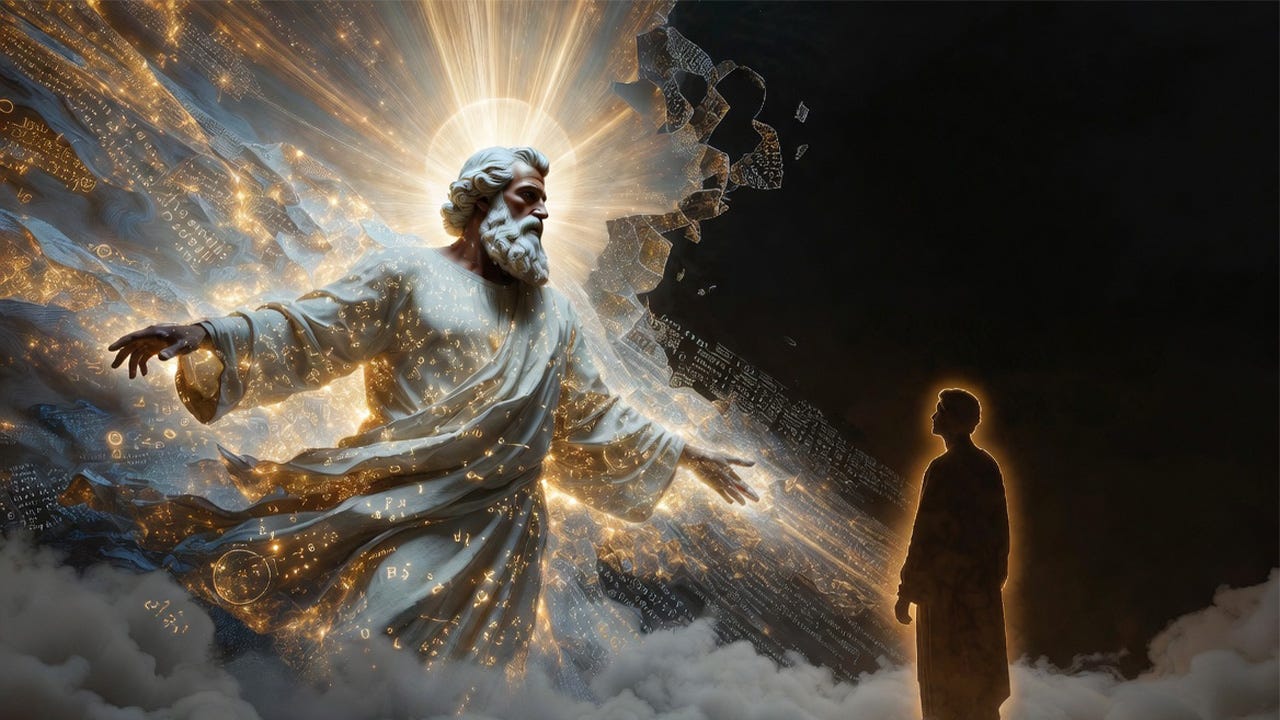
Here’s a question that seems simple until you press on it: if a being knows everything, does it actually know anything?
Think about what knowledge requires. To know that the sky is blue is to distinguish it from every way the sky is not. Knowledge is a figure against a ground. It only carries meaning because it excludes something—error, ignorance, the vast space of what’s-not-the-case. Strip away that contrast and you don’t get perfect knowledge; you get noise. A signal with no background is indistinguishable from silence.
This is an indication that the “omni” traits assigned to the classical God don’t maximize the properties they’re supposed to describe; they destroy them. And once you see that, the entire architecture of the classical deity starts to collapse, not because God is too mysterious to understand, but because the concept is structurally self-defeating.
What Personhood Requires
Before examining what omni-traits do, we need to be clear about what they’re being applied to. The classical God isn’t just a force or a substrate. Theism insists on a person—a being with will, knowledge, intention, and the capacity to act and relate. Prayer makes no sense addressed to a mathematical principle. Worship implies a “who.”
So what does personhood actually require?
First, it requires a boundary. To be a self is to be this and not that. Identity is contrastive at its core. “I” only means something because there’s a “not-I” it excludes. A being without boundaries isn’t a very expansive self; it has no self at all, because selfhood is precisely the operation of distinguishing inside from outside.
Second, it requires perspective. A person is located, not necessarily physically, but logically. To have a point of view is to be here and not everywhere simultaneously. Perspective means some things are closer, some further; some known directly, some inferentially; some relevant, some not. Remove location, and you remove the conditions that make a viewpoint possible.
Third, it requires lack. This is the most counterintuitive requirement, but it’s the most important. Agency—the capacity to want, choose, and act—is only possible where there’s a gap between the current state and a desired state. You can only will something if there is something you don’t yet have. Desire is structurally dependent on absence. A being that already possesses all outcomes, all power, and all knowledge cannot want anything, because want requires an unfulfilled condition. Without that gap, there’s no will, just a static totality.
Fourth, it requires an Other. Identity is forged through relation. A self is defined partly by what it encounters, what resists it, what it can’t simply absorb. If there’s nothing outside the being—no genuine Other—then there’s no friction, no encounter, no relationship; there’s only infinite solipsism.
These aren’t arbitrary philosophical preferences. They’re the minimum structural conditions for what we mean when we say “person.”
Now run the omni-traits through that filter.
What the Omni-Traits Actually Do
Omniscience doesn’t maximize knowledge. It collapses the conditions that make knowledge possible.
Knowledge is contrastive. It requires a distinction between what’s known and what’s not. For finite knowers, this distinction is real and consequential; we carry maps of reality that are always incomplete, always corrigible, always in tension with the territory. That tension is what makes “knowing” an activity rather than a state.
For an omniscient being, the distinction vanishes. There’s no unknown to contrast with the known. There’s no error to define correctness against. The information is total, which means it’s undifferentiated, and thus, it functions less like knowledge and more like the logical equivalent of white noise—everything present, nothing distinguished.
You can try to save omniscience by arguing that God understands logical negation: God knows all truths and knows all falsehoods as falsehoods, providing internal contrast. But this only relocates the problem. That internal contrast still isn’t the contrast between knowing and not knowing; it’s just a complete inventory. An omniscient being doesn’t come to know anything. It doesn’t reduce uncertainty. It doesn’t update. It simply is the total set. That’s not a knower. That’s a database without a user.
Omnipotence doesn’t maximize agency. It eliminates the conditions that make action real.
Action requires resistance. When we say someone did something, we mean they exerted force against friction—physical, social, logical, or otherwise. The doing is defined by the overcoming. An omnipotent being encounters no resistance by definition. There’s nothing to overcome, no effort required, no gap between intention and outcome.
Without that gap, “action” becomes a meaningless term. If willing and achieving are identical—if the distance between desire and result is exactly zero—then there’s no act, only an eternal fact. The being doesn’t do things. Things simply are, in whatever configuration the being’s will coincides with. That’s geometry, not agency.
Consider the stone paradox—can God create a stone so heavy it cannot lift it? This is usually treated as a clever puzzle, but it’s pointing at something deeper. The standard deflection is that God can only do what is logically possible, not what’s self-contradictory. But that concession defeats itself: all it establishes is that God can only do what God is able to do, bounded by his own nature. That’s not omnipotence. That’s a very powerful being with structural limits, which is exactly what the omni-prefix was supposed to eliminate.
Omnipresence doesn’t maximize presence. It eliminates the perspective that makes presence meaningful.
To be present somewhere is to be absent somewhere else. Presence is defined by location, and location is defined by contrast. If I’m here, I’m not there. This isn’t a limitation; it’s the logical structure of what “being somewhere” means.
An omnipresent being is equally everywhere, which means it has no here, which means it has no perspective—no location from which things appear closer or further, more or less relevant, this way or that way. The self that was supposed to be present everywhere has instead dissolved into the spatial fabric itself. It isn’t in all places. It is all places. And a place is not a person.
The Abstraction Argument
The most precise way to state what’s going wrong: omni-traits are limit concepts, not instantiable properties.
Consider infinity. Infinity is an enormously useful mathematical concept. It tells you the direction in which a sequence is heading, describes the behavior of functions at their boundary conditions, and it’s indispensable in calculus, set theory, and logic. But you cannot arrive at infinity. It’s not a very large number you eventually reach if you count long enough. The moment you try to treat it as an actual quantity rather than a directional concept, the math breaks down.
Omni-traits work exactly the same way. “Omniscience” is useful as a limit concept—it describes the direction in which knowledge points as ignorance approaches zero. “Omnipotence” describes the asymptote toward which power tends as resistance decreases. These are valuable conceptual tools for thinking about knowledge and power as abstract quantities, but they’re not properties a being can possess, for the same reason infinity is not a number you can possess.
The moment you try to instantiate them in a person—to say “this entity has omniscience” the way a person has a name or a perspective—you’ve committed a category error. You’ve tried to place a limit concept inside a bounded entity. The limit concept wins. The bounded entity disappears.
Others Have Noticed This
Charles Hartshorne is the most significant and interesting voice here, because he was a theist. He believed in God and still concluded that the classical omni-God was incoherent as a person. His process theology argued that a being incapable of change, learning, or being genuinely affected by the world is not a living being—it’s a static abstraction. To preserve God’s personhood, Hartshorne argued, God must be finite in relevant ways: capable of relation, of growth, of genuine encounter with an Other.
A theist concluded that omnitude destroys personhood. That’s worth sitting with.
Patrick Grim made the point more formally on omniscience specifically, using Cantor’s theorem to argue there can be no coherent “set of all truths” for any knower to hold. The structure of truth itself, he argued, outruns any possible container, including an omniscient mind.
Both are pointing at pieces of the same problem. The full structural argument is this: omni-traits don’t describe a maximally perfect person; they describe the conditions under which personhood becomes impossible.
A Finite God Makes More Sense
The question my analysis raises isn’t whether God exists. It’s whether the dominant conception of God is even internally coherent; and the answer, on structural grounds, is no.
A being with genuine omni-traits is not a very powerful, very knowledgeable, very present person. It’s the substrate of reality—the total sum of information, the complete causal structure of the universe, infinite space itself. Call it what you want, but it has no face. It can’t want anything, know anything in the way knowing requires, or act in any sense that distinguishes act from fact. It’s not a person; it’s a description of everything, which is to say, a description of nothing in particular.
The “omni” prefix doesn’t elevate a person to perfection. It dissolves the person into an abstraction.
But here’s what’s interesting: a finite God actually makes more sense of the record. A God who doesn’t know what his creations will do—because he isn’t everywhere and can’t foreknow the future—is a God who runs experiments. Like a scientist who breeds the mice and watches what they do, God fathers his children and discovers who they become. That God has reasons to test, reasons to feel wrath, reasons to grieve. The problem of evil stops being a philosophical embarrassment and becomes an expected feature: of course there’s suffering a finite God cannot stop. He made the conditions, but he didn’t script every outcome.
This version of God is coherent in a way the classical version never was. Not all-knowing, but deeply knowledgeable. Not all-powerful, but formidably capable. Not everywhere, but perhaps very far-reaching. A being with a perspective, a will, and genuine stakes in how things turn out.
The classical God of omnitude isn’t theology. It’s mathematics that forgot it was mathematics.
Which leaves the question classical theism has never seriously answered: if you strip away the omni-traits that make God logically impossible, what remains? Perhaps something stranger and more interesting than the textbook version—a God small enough to be a person, invested enough to have a will, and limited enough that what happens here actually matters to him.
Just read your piece - great job once again, man.
I guarantee you and I are the only Atheist Right voices on social media right now. I’ve been one for many years, but I had to keep it quiet because so many of my conservative friends (both Jews and gentiles) are deeply religious.
But how can anyone still believe in an invisible boogeyman when there is literally zero evidence for it?
By the way, I’m also huge on AI innovation. It is the future. If we keep dwelling on religion and studying the Bible or Torah instead of leaning into AI, we’re going to get left behind.
I’m planning to take more courses in AI for my main job and my businesses because this is the way - the only way.
Thanks for validating me, Lucas. We may disagree on Dan Bilzerian, but these are some of the greatest pieces you’ve written. Too bad so many people will be way over their heads with them.
We can only pray for them - to science! 😂
I really liked this article as much as I understood it. I never expected when I first followed you years ago that you were a thinker.
The only thing I wonder about is the idea that God has to be somehow logically coherent in terms of human reason, or that our understanding of Him is somehow based in a structured perspective of space and time.
I'm not certain the idea of God as traditionally understood as person in Western terms has anything to do with boundary, or finiteness of the binary nature of the universe. If God is everything, omni, light love life as the Bible says, then darkness maybe creation itself, the very structure from which we perceive anything, and human reason may not be capable of resolving paradoxes. What if structure and coherence are the very limiting factors to understanding infinity or God. The self and the I require contrast in our world, but we don't know what's beyond, or even deep within, as Carl Jung might put it. Knowledge from our perspective may require contrast, but from a state of non-division or unity, where binary may not exist, complete knowledge may be reality itself.
Using the Big Bang as a model, It's not clear that in a world of singularity without space and time, that contrast is even needed for presence, knowledge or power. What even is time? What even is determinism. These are fundamental questions of physics that have yet to be answered. At the level of singularity and Big Bang, what does boundary even mean. Films like Intersteller suggest ideas around this, referencing the Tesseract of Zero Point Energy. We wouldn't be aware from our perspective, of a reality where space and time don't exist, where all actions are already complete, that there was nothing to overcome, or was overcome before it even started. Time and boundary may give the illusion there is personal human identity, or perspective, or lack, or desire, a state without knowledge, or even will to action. These are all concepts of a finite view of the universe, where boundary is the only thing that gives meaning.
Within creation, if we are to believe Chaos theory and sensitivity to initial conditions as a model representitive of reality, not a computer generated illusion, even white noise has structure and signal. Nothing is random. It only appears to us without structure from our limited perspective.
My understanding of infinity is that it should be numerically, and a reason it causes so many problems, like unifying QM and GR, is that we ignore it. Including it in equations causes too many problems we don't know yet how to solve. But excluding it ignores it's reality as a concept, especially the effective infinite nature of Zero Point Energy discovered by the Casimir Effect. Returning it to it's rightful place in the structure of equations used for both QM and Relativity maybe a necessary step before it either cancels out to solve unification, or we discover the mathematics to handle it. The very nature of fractal geometry proves that infinite processes exist within finite boundaries, so it can't be ignored mathematically.
Boundary conditions create reality that we are familiar with. As Nassim Haramein puts it, what we know of as a proton is a boundary condition between the pressure of outward expansion of universal ZPE within it, and pressure of cosmic energy without. An event horizon is created where both forces balance. The expansion of Zero Point creates the necessary condition of cosmic energy that balances it's own expansion, creating the very idea of boundary and separation, perspective if you will. But everything originates from One energy where there is no space time or matter descriptive of a binary universe. And his standard Newtonian equations seem to suggest this. He doesn't need to invoke the flakey disembodied nature of probability or Quantum Mechanics or Shrodinger’s Cat, or Relativity which breaks down at cosmic black holes.
So mathematics, geometrical structure and logic as foundational realities of a deterministic universe may themselves be boundary conditions between creation and from wherever it came. There isn't any evidence that those things exist outside of what we know.