
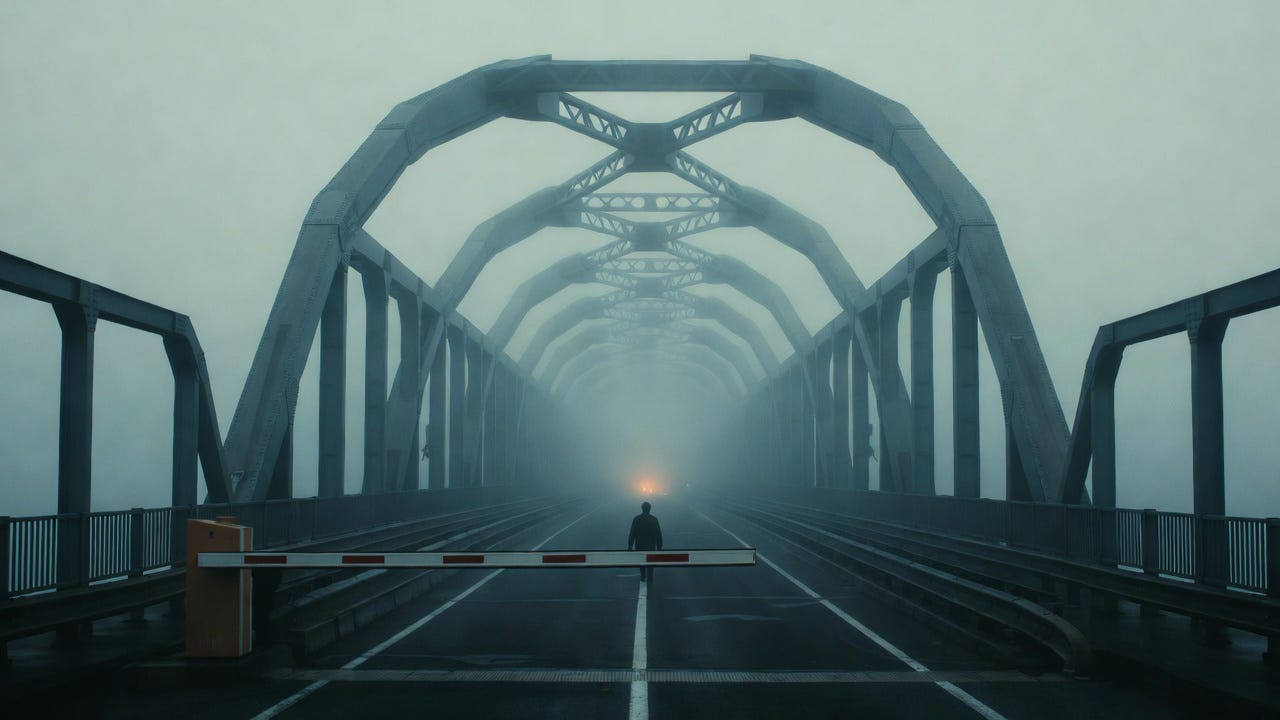
We in the West are in an information war. Not everyone wants the two sides to talk. Plenty of people on both ends say so out loud: the other side shouldn’t be debated; it should be destroyed. And the few who do try to talk get hit from both directions. The toll is high.
I left the movements I was in convinced that bridges have to be built and that it’s the only way forward. What I want to explain here is why almost nobody builds them.
It comes down to two mechanisms I wrote about a few weeks ago in The Seven Preconditions of Conspiracy Thinking—self-sealing and the echo chamber. That piece was about how a person gets into a conspiracy theory. This one is about what two of these mechanisms do to each other once they both exist and why the space between them is so expensive to occupy.
Suppose someone says, “The Jews did 9/11.” Someone reports it to an organization that tracks antisemitism. That organization gathers information and shares it with every other anti-hate organization. Together, they launch a campaign to destroy him—job, reputation, platform, whatever is reachable. The people who agreed with him watch the destruction and conclude that he was telling the truth, because, as the quote that’s always misattributed to Voltaire goes, “To know who rules over you, find out who you can’t criticize.” And people see what happened to him for saying what he did, concluding that’s the group that runs everything. Then more of them say it, louder, forming the echo chamber that confirms their claims.
Despite what you may believe, both sides of this issue are not being irrational. The people doing the destroying are responding to ideas that led to expulsions and mass murder. The people watching are responding to what they just saw happen to a man for speaking, which other historic figures, who did the previous expulsions and mass murders, claimed would happen.
The cycle doesn’t need anyone to be coordinating it, because each side’s response is exactly what the other side requires in order to keep this loop going.
This loop is created by what I call self-sealing: credibility gets assigned by conclusion rather than by source. Once that’s in place, there’s no longer any evidence that can count against the belief, because all the evidence arrives pre-interpreted.
The echo chamber is what guarantees the cycle keeps firing, and it does it by punishing anyone who tries to slow it down. Ironically, both sides are in self-sealed echo chambers, while they believe only the other is, creating this loop that actually depends on the other.
Say in one room that the man who just got caught saying something antisemitic is probably confused rather than evil, and you’ll be told you’re defending a Nazi. Say in the other room that a particular criticism isn’t antisemitism—that the claim is simply wrong rather than sinister—and you’ll be told you’re making excuses for people who want you dead. In both cases the response isn’t an argument but a reclassification. You stop being a member in good standing and become someone to be watched.
Most people would rather not deal with that, so they comply. Not out of cowardice, but out of arithmetic. Staying quiet costs nothing, whereas speaking up could cost them everything. The result is that the only voices left in each room are the ones producing exactly what the other room needs to hear. Each side’s loudest members manufacture the other side’s evidence, and the people who could have interrupted it have been quietly subdued.
I should be very clear about this, because “both sides are in self-sealed echo chambers” is one sentence away from “both sides are equally wrong,” and that isn’t what I’m arguing.
The triggers are not evidentially equal. One side is reacting to institutions that lied about matters of war and death—we invaded a country over weapons that weren’t there, and I was in it. The other is reacting to pogroms. The claims are not the same kind of claim. One asserts that a hidden group controls the world, which is a statement about reality that can in principle be checked. The other asserts that a stated idea is dangerous, which is a statement about speech and consequences.
The failure modes are nowhere near each other in scale. When the enforcement side gets it wrong, an innocent man loses his job and his name. When the conspiracy side gets it wrong at scale, you get the twentieth century. Regardless, the same mechanisms are at work, and they must be made known.
We must take this seriously and ask, what will this unchecked loop cost society in the next twenty years?
People who believe in conspiracy theories are not going to disappear. With the advent of the Internet, they’re now able to spread like wildfire overnight. In addition, a share of them are young, and they are going to end up in offices, in media, in staff jobs, or in government. If no conversation ever happens, then that cohort arrives in power with its beliefs fully sealed and never once seriously contested.
On the other side, the old guard watching them arrive will reach for the only tool it has practiced, which is destruction at scale. That is not a de-escalation. It’s war.
But the danger many people fail to see is that every anti-American, anti-West actor would love nothing more than to see those of us living in the West spend the next two decades destroying each other rather than finding ways to build bridges and counteract the psyops that created these divisions in the first place. That’s the gap our enemies want widened, because a wider gap does their work for them.
So why doesn’t anyone else want to build bridges?
For the grifter, it’s because there’s no money in it; for our enemies, it’s because it could unite us; and for the disheartened, it’s because they think it’s impossible.
I disagree that it’s impossible. In fact, I know it is possible, because the way I snapped out of all the psyops was because someone decided to walk on the bridge I created to find common ground, in hopes of healing wounds and preventing further damage from occurring.
But nobody walks onto a bridge for free, because it costs the same thing from either end. A Jewish man who says out loud that some guy’s question was ignorant rather than evil pays what I pay for saying a claim about Jews is false. Both of us get told we’re helping the enemy. That’s the toll, and the bridge doesn’t get built by anyone unwilling to pay it.
The only way a bridge can be made and crossed is if we all step out of our self-sealing echo chambers and take heat from the disbelievers for doing so and risk the possibility of failure. But if we don’t try to build bridges properly, then we can only blame ourselves when things continue to get much worse as the gap widens further and further, until no bridge could be built at all.
Lucas, I understand what you're saying about building bridges, but I think you're overlooking a fundamental problem. YOU were able to engage in these debates because you had the intellectual capacity to do so. But not everyone has your IQ. Not everyone is created equal intellectually, and unfortunately, some of the people spreading these lies are so stupid that there is simply no productive debate to be had with them. You cannot reason with someone who lacks the ability or willingness to understand basic facts, no matter how much evidence you put in front of them. You see what they are doing to you... can one conduct an intelligent dialogue with people like Khaled or Bryce Mitchell.
Then you have an entirely different category of people: Eric Orwoll, Stew Peters, Owen Shroyer and others who are monetizing Jew-hatred. They're building platforms, fundraising, attracting audiences, and making money by spreading hatred against Jews. This isn't simply a matter of ignorance or people being misinformed. For some of these individuals, antisemitism has become a business model. The see someone like Shiloh Hendrix make over $700K by using the N word - and they want to do the same thing to the Jews.
And here's the real danger: people who ordinarily might never have had a problem with Jews are being drawn into this because hatred is being packaged, promoted, and monetized. These personalities have a financial incentive to keep their audiences angry and suspicious of Jews. Why would they stop when the hatred pays? Look at Jake Lange - a Jew.. standing in front of a Florida Jewish Housing Development with a sign talking about assimilation. Craziness, right? Is he going to go do the same to the Amish next?
So how exactly do you propose building a bridge with people who have built an entire business around destroying it? You can't reason someone out of a position that they have a financial incentive to maintain.
That's why I have absolutely no problem with organizations like StopAntisemitism, Canary Mission, and others calling these people out and exposing what they're doing - then going after their sources of income based purely on hate. These haters are creating hate chambers, and those chambers need to be exposed. We cannot sit back and pretend that dialogue alone will solve a problem when some people are actively profiting from making it worse.
I'm all for dialogue when dialogue is possible. But there has to be a recognition that not everyone is reachable, not everyone is arguing in good faith, and not everyone wants a resolution.
Sometimes fire has to be fought with fire. Building bridges is worthwhile, but not at the expense of allowing people to turn Jew-hatred into a profitable industry without being challenged. There's a time for dialogue, and there's a time to fight back.
Excellent article, as usual.
The winning narrative is the divine narrative.